Showing posts with label Action. Show all posts

Monday, December 19, 2011

24 Days of Christmas- Yippeekayyay Edition

One of my non-obnoxious Film Studies TAs was struggling to explain to us the basics of plot. We were first year film students, dying to do avante-garde and unique things, and the idea of using standard structural elements to construct our opuses felt confining and uncomfortably like selling out. Then, she walks in one day and puts on Die Hard. For the next two hours, she presented Die Hard to us as a master class in plot development. Needless to say, I now think Die Hard is pretty much amazing. It’s a masterwork in quiet characterizations and blunt, effective story telling, and Bruce Willis has never been better than he is playing the damaged McClane. And there’s really nothing more Christmasy than fighting terrorists*

Die Hard follows the story of John McClane, a New York City cop visiting California to see his estranged wife, Holly, and kids. He decides to surprise her at her office, and while cleaning up in the bathroom, inadvertently manages to hide from the Scandinavian terrorists taking over the building. These terrorists are led by Hans Gruber (Alan Rickman) who is at turns menacing, genteel, and maniacal. The terrorists are not really terrorists; they’re thieves, and they would like to steal from Holly’s firm’s corporation.

In a way, Die Hard is a grown up Home Alone. Alan Rickman is Joe Pesci, Bruce Willis is Macauley Culkin, and Holly and all of her coworkers are the McCallister’s house. It’s all in the name of Christmas, and bringing his family back together. Along the way, Kevin/John McClane has to lay a series of traps, outsmart the bad guys, and crawl around using the absurdly serendipitous tools at his disposal. I’m not sure who Carl Winslow’s Sergeant Al Powell is; maybe the creepy, semi-homeless guy Culkin befriends. Our hero even maintains his sense of whimsy, like Kevin using the old gangster movie to trick the robbers, or McClane putting a Christmas hat on and painting “Now I Have a Machine Gun Ho Ho Ho” in blood on a dead robber’s sweatshirt. Now, Kevin may never have killed the robbers by hitting them in the face with a gun and then throwing them down a flight of stairs, but I bet he would have if he’d had the training. Gruber tears apart McClane by saying he is “Just another American who saw too many movies as a child; another orphan of a bankrupt culture who thinks he's John Wayne.” If that’s not an apt description of Kevin McCallister, I don’t know what is.

Die Hard works so well because the characters all make pretty much logical and believable decisions. John doesn’t rush in to fight the robbers with nothing but his sense of his own badassdom. He tries to contact the authorities and gets as much back up as possible. Holly doesn’t huddle in fear OR try ridiculous amounts of heroics. Instead, she works her hardest to keep people safe and comfortable inside. The generic cops may make stupid decisions (like storming the building with SWAT team members with the mistaken belief that clearly there aren’t any hostages and the dead dude on the cop car was just a “depressed stock broker”), but Seargant Al Powell remains the human face of police officer sanity.

A really great movie is one that manages to humanize every character. In Die Hard, everyone from Seargant Al Powell (whose fully-realized back story provides an emotional anchor to the film’s final act) to Hans Gruber to John and Holly McClane are full people capable of emotions, motivations and character arcs. That’s a lot to ask from an action movie with this many shoot outs. As the conflict escalates between the Thieves, McClane and the LAPD, the sense of reality should fly out the window. Instead, Die Hard cleverly walks the realism line, at least as far as an 80s action movie can. When cheesy 80s yuppie Ellis tries to negotiate as douche-ily as possible with Hans Gruber, and earns a bullet in the head as a result, the real life consequences of all the Home Alone-style theatrics are brought carefully home. Gruber and McClane start an epic cat and mouse game, the highlight of which is when McClane stumbles upon Gruber crawling around the ventilation ducts, and Gruber pretends he’s a hostage. The tension-riddled scene where the two talk without full knowledge of the other’s story, with Gruber trying to needle out information from McClane, is probably one of the greatest moments of relative calm in a movie full of bloody action sequences.

Of course, the ending is suitably over the top, the douche FBI guys are suitably callous, and McClane’s particular brand of stalwart heroism comes out on top, bloody, bloody top since by the end of the movie he has no shoes or shirt, and is constantly falling through glass. But, like in all good Christmas movies, McClane bucks the system that tries to keep him down, reunites with his family, and ultimately has hope for another year of overtly American badassery, all set to “Let It Snow.”

Random Observations: 
• 99% Watch: The whole movie sets up a contrast between blue collar John McClane and the obnoxious, cocaine-soaked 80’s yuppies who uselessly populate Holly’s firm.

“You’ll have to forgive Ellis. He gets very depressed this kind of year. He thought he was God’s greatest gift.”

Die Hard is one of those pre-2000 movies where the entire plot would have to be rewritten today due to cell phones.

• Important lessons learned from Die Hard: All blond men are liars, and blond men with long hair are the worst. You should never trust somebody in a sweat suit. Don’t take off your shoes at an office party, because at some point you WILL have to walk through glass. Also, the FBI are mostly d-bags.

*I feel there may be a drinking game to be played while reading these reviews, whereby every time I describe something as “nothing more Christmasy” or “The true meaning of Christmas,” you take a shot. This game would be dangerous to your health, and I in no way endorse it.

Tuesday, November 15, 2011

March 23rd: Be There


by Kelly Bedard 

The official Hunger Games trailer hit the world like a flaming District 12 tribute today after Josh Hutcherson (who plays fan favourite Peeta Mellark) introduced it on Good Morning America.

The superb, pulse-pounding teaser kicks off with the serene Jennifer Lawrence as heroine Katniss Everdeen meeting her tried and true best friend Gale (Liam Hemsworth) in the woods for their daily hunt. It's as peaceful a scene as Katniss ever enjoys and the sense of foreboding in Gale's pleas for them to run away together gives just the right sense of unease. Then we're on to the grey-tinted Reaping and Elizabeth Banks' frothily icky take on Effie Trinket, Lawrence's screams, the face of her terrified young sister Prim. The rest is a flash- the train, the prep team, Cinna's designs, Haymitch's training, Caesar's interviews and that crucial scene on the roof when Peeta first shows us who he is. 

Saturday, October 22, 2011

Style, Punch and a Whole Lotta Driving


by Kelly Bedard

Ryan Gosling is on top of the world. With no fewer than 3 major major movies currently in theatres and Oscar buzz starting up again, Gosling is named-checked as The Guy right now, the one that all other men are stuck never living up to. But Ryan Gosling is a gangly Ontarian with floppy hair and a goofy smile. Isnt' he? At least that's the kid I grew up loving on Breaker High back when I was the only kid I knew who knew his name. Then he conquered the world, making everyone fall in love with him in the process- and my possessive pride is kicking in.

Wednesday, August 10, 2011

Cowboys, Aliens, and other uninteresting things

by Rachael Nisenkier

What if the director of one of the most enjoyable superhero movies of the past ten years (Jon Favreau) and the charismatic star of the well-received James Bond remake (Daniel Craig) teamed up with a rough and tumble Indiana Jones (Harrison Ford) to make a movies western that features extraterrestrial life, and whose title is a cute pun (Cowboys and Aliens)?

Goofy I was expecting, maybe a little implausible. Yawn-inducing didn’t really even enter the picture.

Cowboys and Aliens fails at the number one component of the successful summer Blockbuster: entertainment. It’s got kick-ass explosions, suitably bad-ass acting from Craig and Ford, and a pretty cool concept. Yet somehow, despite all of that, the film is as lifeless as the towns left deserted by the alien menace.

Monday, July 25, 2011

Captain America, the set up

by Rachael Nisenkier

Watching Captain America feels a whole lot like watching a so-so pilot episode for a TV show you really want to watch. In there are all the elements that you know you’re one day going to love (more on that later), but the actual substance of the episode seems more about putting the pieces in place for the show to come than it is about what’s actually going on.

Anticipating the Avengers

by Rachael Nisenkier

I’m officially nervous.

It was sitting in the back of my brain during the post-credits sequence of Captain America. And as I breathlessly indulged in comic-con coverage on entertainment websites, it just sat back there, percolating, bubbling up into my cerebellum. It brings unbidden images of middling box-office numbers, critical dismissal, and fan eruptions of anger.

I’m nervous because Joss Whedon is directing and writing The Avengers! There, I said it.

I love Joss Whedon in a way most people reserve for people they’ve actually met. I love his easy going nature in interviews, the stories of Shakespeare parties, his feminist rantings. But mostly, I respect the crap out of his work. He’s a great writer and an increasingly impressive director, who has turned in some of the best episodes of television of the past twenty years. He’s played with the form and constantly seems to want to expand what he is capable of. He’s ambitious, innovative and intelligent. He’s also a huge nerd. His run as a writer on the X-Men comics was funny, smart and really true to the characters. His Buffy Season 8 comic managed to really take the form by the hand and lead it into this strange, mystical, uniquely Buffy world. And he imbues even his most mainstream work with his nerdy bonafides. So why does it scare the crap out of me that he’s helming The Avengers?

Tuesday, July 19, 2011

Goodbye and Thank You Harry

by Rachael Nisenkier

I have a long history with Harry Potter. I got the first book when I was 11. I read the last one my sophomore year of college. The books and movies have been there for me from pigtails to braces to paychecks, and everything in between. Last year, when Harry Potter and the Deathly Hallows Part 1 came out, I unpacked my Harry Potter baggage here.* And when the movie came out, I reviewed part 1 here.

I start with my history because Harry Potter and the Deathly Hallows Part 2 is a uniquely reflective film. Every image in it has been built to reflect the movies that came before it. In the requisite movie marathon that came with the release of the newest film, I recognized one major shift in having David Yates take over the director’s chair for the last four films. Yates, maybe due to the benefit of having most of the books out for all of his movies, seems uniquely aware of and concerned for cinematic continuity and for creating a universe within the movies that makes sense, thematically, logically and emotionally. 

The films will never have the span of the book. They’ll never be able to fit in all the subplots, all the Ron Winning At Quidditch, all the Hermione Saves The House Elves, all the complicated bits of magical lore that explain possession of the Elder Wand. But where Yates excels is creating a cinematic universe that makes sense and to which Deathly Hallows Part 2 is a near perfect conclusion.

Friday, July 8, 2011

Green Lantern and his panty-wearing friends

by Rachael Nisenkier

I have a theory. I like to call it the “panties of justice*” theory. It’s about what separates easily adapted superheroes from the ones who seem to struggle on their way to the multiplex. It’s basically the difference between Batman and Wonder Woman. Both are noble creatures with a complicated, fascinating backstory and great personal strength. Yet one of them fights crime while wearing a state of the art suit of body armor, and one wears the panties of justice. In the world of comic books, or their cartoon adaptations, the panties of justice look just fine. We buy into them. But on the big screen? It’s hard to take a heroine seriously who chooses to outfit herself in what amounts to little more than a patriotic bathing suit.

Tuesday, July 5, 2011

The Feminist Argument

My Cinema's senior staff writer Rachael disagrees with Kelly's thoughts on Bridesmaids (found here). So we thought we'd publish her article too, and let you decide. The last time this disparity happened we ended up with two of our most popular and most controversial articles ever (Black Swan: Love and Hate). Read on after the jump for Rachael's feminist take on Bridesmaids, Bad Teacher, Transformers and more.

Thursday, June 30, 2011

At the Cineplex

Summer brings with it just a few guarantees: hot weather, kids out of school and blockbuster season at the Cineplex. With so many big budget, massive star vehicles charging into theatres (along with some lesser-known experiments), we at My Cinema are always struggling to keep up. So, here's a quick overview of some of the films we've seen in recent months- the ones that didn't quite warrant the full review treatment but deserved a mention nevertheless.

Read about Bridesmaids, Arthur, Water for Elephants and Pirates of the Caribbean: On Stranger Tides after the jump.

Tuesday, June 7, 2011

First Class

Kelly recently reviewed the excellent Thor and in her review mentioned that I'm a bit of a superhero nerd. I actually think I'm the perfect amount superhero nerd: knowledgeable enough to enjoy the films and add a bit of depth to moments like Cyclops saying in the first X-Men, "What would you prefer, yellow spandex?" But I'm not so much of a nerd as to be bothered, or even really notice, continuity errors or changes from the originally, especially not in Marvel properties. As such, I'm exactly the audience Marvel wants for these movies: enthusiastic to the point of rabid, yet easy-to-please.

And the thing about Marvel is, with few exceptions, they've been doing a damn fine job of pumping out movies that both provide fan service and truly good, serviceable films. Mostly, they do this by hiring people actually suited for the job. On Thor, the man who it turned out could best bring to life the grandiose absurdity of Asgard was Kenneth Brannagh, and the only guy I could imagine balancing on the tightrope of slapstick fish-out-of-water comedy and hubris was Chris Hemsworth. For X-Men: First Class, that's Michael Vaughn (Kickass) as well as stars James McAvoy and Michael Fassbender.

About halfway through First Class I found myself wondering if the movie was going to suffer from what people refer to as "prequel-itis." This occasionally debilitating disease robs films of their dramatic tension, due to the fact that we all know how they end. But the knowledge of where Magneto, Mystique, Professor X and the others end up adds an element of grandiose tragedy to the buddy story, even in its most lighthearted moments. Enjoying that montage where Fassbender's Magneto and McAvoy's Xavier exude a cocky enthusiasm as they track down mutants? Flash forward to Ian McKellan locked in a plastic prison at the beginning of the first film.

On top of that, the reliance on WWII and Cold War imagery adds an element of realism amongst the blue-skinned mutant shenanigans. It really helps to tease out the X-men themes of belonging, acceptance and honor.

X-men First Class is not a perfect movie (in comparison with Magneto and Xavier, for example, Mystique as the third side of that triangle seems underdeveloped), but it's a solid, exciting, well-developed outing that continues X-Men's casting hot streak. It's too bad the opening weekend box office didn't match that of recent smash The Hangover II, but if Marvel continues to be have the best studio quality record short of Pixar, I'm looking forward to even more chances to reenter the marvel universe.

GEEKY SIDENOTES (here be spoilers!):
* I liked the government precursors to S.H.I.E.L.D.
* Jennifer Lawrence's ageing up into Rebecca Romijn was all sorts of brilliance
* Kevin Bacon?! KEVIN BACON!

Sunday, May 29, 2011

The God of Thunder

Rachael is the superhero expert, I freely admit that. When it comes to genre knowledge, franchise history and source material familiarity- I'm not your girl, at least not when we're talking Marvel vs. DC (or whatever it is we're talking). But I've seen my fair share of hero movies. Like everyone, I'm a Batman fan and hold The Dark Knight in the highest regard. I liked the first Spiderman and all three X-Men (the first one publicly, the second 2 not so much), even Iron Man impressed me (though I didn't see the sequel). So I'm going to talk about Thor. If you think that I am wrong about Thor, let me have it in the comments section, because I freely admit that I'm not on my own turf here.

But here we go nevertheless...

Monday, March 21, 2011

The Adjustment Bureau

The Adjustment Bureau could have been a really great film. At its core it's full of interesting philosophical questions, ones that introduce possibilities that both fit into and are new to global spiritual narratives. Ideas of fate, free will and intelligently designed plans are expressed alongside darker ramifications like the sacrifice of potential in some for the ultimate success of others. The thought that the plan for our lives is always being rewritten, that there are angel-like forces at work in our world to enforce it, the fact that there are lingering effects from previous incarnations of our plan, the possibility that our plan involves cutting someone we love's life short so we can be driven to succeed... the fact that there is a plan at all, an architect, the chairman! There is so much intellectual possibility in this film.

And it expands from there. Writer/director George Nolfi plants these ideas into the world we're currently living in and then ties them back through time, using the highs and lows of human history as evidence for his mythology. The whole thing is quite brilliant. But then it starts to break down.

Tuesday, January 4, 2011

Unexpected Golden Globe Nominees

It really is a shame that The Golden Globes, one of the only major award shows that makes a point of acknowledging comedies and musicals, often does such a bad job of it. Academy pretension will most likely keep talented comedy actors like Emma Stone out of the Oscar race, so The Globes is where they are allowed to shine. But the accomplishments of such oft-overlooked achievers are degraded when voters lump them in with less deserving but bigger-name stars just to fill up the categories. E online (among others) has been swiping freely at 2 contenders in particular: The Tourist and Burlesque. One is an over-the-top, nominated-in-the-wrong-category badly executed snooze fest that clearly was nominated to get the star count up. The other isn't actually all that bad.


THE TOURIST

Oh the Mediocrity!

Golden Globe nominee Angelina Jolie walks around a lot. And pouts, she's good with the pouting. Golden Globe nominee Johnny Depp wanders aimlessly, mutters the occasional fun quip then reveals an unenlightened twist.

The setting's nice, the costumes are pretty and I like Paul Bettany (mostly out of residual love from A Beautiful Mind and A Knight's Tale), but that's it. The 2 superstars at the centre of the movie are just that, superstars, not actors. Which is particularly sad because both (especially Johnny) are quite capable of acting circles around so many others. Their complete lack of chemistry is almost alarming and to say the writing was pedantic is the biggest understatement since calling the horrifyingly obvious twist ending merely "unenlightened".

The Tourist is a big-budget, big-stars waste of time. It also in no way qualifies as either a musical or a comedy and yet somehow was nominated as one. But hey, it'll put some more famous faces on the red carpet.

BURLESQUE

The seemingly showy musical, on the other hand, lacks the self-important grandiosity of The Tourist. For all its sequins and glitter, Burlesque possesses an almost self-deprecating simplicity and is no worse off for it.

Unlike last year's glitzy musical Nine, Burlesque sports a cast of oft-mocked, remarkably talented folks instead of Oscar winners and their pal autotune. Perfectly cast, Cher's identity as a somewhat has-been but still utterly fabulous icon lends a brilliant melancholy to her character, a trod-upon diva too tough to acknowledge defeat and too passionate to back down. Her musical number "You Haven't Seen the Last of Me" is an aching anthem of "this is Cher's world, you're just watching it" diva-ness. And speaking of divas, there has never been, nor will there ever be anyone quite like Christina. Other than the aforementioned ballad, the film's songs are generally uninspired, but in the hands of the definitive beltress, they shake the floorboards. The pint-sized fireball raises the standard ingenue-with-a-dream character to new heights, not with outstanding acting, but by giving her the voice that makes her deserving of that dream.

The writing is pretty rocky, but the film is well-paced and the audience too entertained to care. The romance storyline is well-developed, aided in no small part by the crazy chemistry between Christina and Cam Gigandet (who somehow manages to come off as trustworthy despite his perfect abs and guy-liner). Stanley Tucci also adds some cred to the film with his wonderful role as Cher's best friend (but I've never not loved Tucci, including that time last year when he played a serial killer).

But it's the idea that this cast needs extra cred that I think is a problem. True, Christina is not an actress, but the role really requires a singer, and no one's better than her. Cher, however many years ago it may have been, is an Oscar-winning actress. Alan Cumming and Peter Gallagher are respected Broadway performers. Julianne Hough and Chelsea Traille are some of the brightest dancing talents in North America (and Hough's presence lends a fun irony to a tongue-in-cheek Dancing with the Stars joke). Gigandet is just plain good in the role, who cares if he was once on The OC or had a part in Twilight. The rest of the excellent cast is filled out by actors whose biggest crime is that they work predominantly in TV: the always-great Eric Dane from Grey's Anatomy, Kristen Bell (one of television's great heroines as Veronica Mars, whose been slumming it in her last few films), the charming Glee star Dianna Agron, even the lesser-known David Walton (100 Questions) makes his mark on the film. The cast of Burlesque truly is excellent, they're just not "movie stars".

Don't get me wrong, I don't think Burlesque is the greatest film of the year, I don't even think it's close. But it is underrated. It's not even close to bad. It's entertaining, decently executed and shows off some really talented people. It's a solid movie musical and deserves not to be laughed at for being nominated as such. It's at least better than Mamma Mia!, but that had bigger stars- I'm just saying.

Monday, December 27, 2010

Enjoying The Fight

The Fighter is the latest effort from controversy magnet David O'Russell. Although he may be best known to the general public as being a brief viral sensation thanks to an expletive filled diatribe aimed at Lily Tomlin on the set of I Heart Huckabees . However, I have loved him since his work on the subversive, chatty, and also-Mark Whalberg filled Three Kings.
In a lot of ways, The Fighter is best interpreted through the lens of someone who has seen and loved most of O'Russell's movie, and it is also, coincidentally, one of the best movies in his wheelhouse. It uses the boxing/true life underdog story troupes masterfully to tell a story that is purely O'Russell. See the trademark witty dialogue, deeply flawed and interesting characters, and add in a dash of Lowell, Massachusetts flavor, and you get a movie that feels at once worn (unless this is an oscar-winning Clint Eastwood movie, most sports films end one way and one way only) and invigorated, as though the freedom from subverting plot cliches allowed O'Russel to delve so deeply into his characters that the actors seem alive to an extent that even the most talented among them has been missing lately.
So let's talk about those actors, shall we? We'll start with the most obvious: Christian Bale. To say I am a fan of Christian Bale's work is a pretty huge understatement. I've seen nearly every film he's ever made, and as such I know exactly how much range and depth he has in him. He's a chameleon of a character actor trapped within the body of Batman. Early in his career (or earlier, at least) he played this for all its worth in the fantastically bloody American Psycho, but his ability has transcended work in far less showy films as well (Rescue Dawn, Swing Kids, Empire of the Sun, Laurel Canyon, to name a few). However, over the past three or so years, he's mostly been relegated to bringing over-serious gravitas to action films of varying degrees of interest.
What The Fighter does for Christian Bale, and this is kind of surprising given that he plays a semi-emaciated crack addict whose emotional journey is the hinge on which the plot rests, is allow him to be the comedic relief. Sure, this is dark-as-dark comedy, but the ability to loosen up and swagger about the screen with the convoluted rhythms of a hyperactive ex-boxer really allows Bale to shine in a way he hasn't for the past couple of films.
As for the rest of the cast, Mark Whalberg puts his marky mark abs to good use, but mostly he brings a quiet, muted heart to the film. If we don't believe in Whalberg's Mickey, in his love for his family, love for his self, and love for boxing, then we don't buy the movie, period. And Whalberg gives a career best leading performance by allowing his rage, and hurt and promise to simmer beneath the surface. Playing a kid from Massachusetts who almost, but not quite, let's rage and drugs and a crappy childhood override his promise isn't exactly a stretch for the kid (seriously, read his biography on wikipedia sometime. It's fascinating stuff), but Whalberg never seems like the caricature that Andy Samberg once captured so nicely as, "Hey goat, did you see that movie the perfect storm, goat? I was in that movie. Did you like that movie goat? Say hello to your mother for me, okay?"
But the true super star of the bunch is Amy Adams, who manages to play "that woman Charlene" with a street smart intensity that seems surprising from a woman who once completely embodied a live action Disney Princess. Although her part is not quite as showy as some of the others in the film, its her mouthy, tough-as-nails Charlene whose the fuel on the fire of this film.
Of course, The Fighter is NOT by any means a perfect film. As said before, it follows the boxing movie cliches a little too closely, and it might have been easier to take had the film always seemed in control of its own hackneyed antics. On top of that, the last fifteen minutes, Mickey's crowning glory, are cheesy, even if you (like me) are so invested at this point of the film that you're clapping as though Mickey can hear your support. It's as though O'Russell spent so much energy crafting these characters and actors perfectly that he simply lost energy in putting the same verisimilitude into the final 15 minutes.
But that's okay. To an extent, The Fighter works because of and in spite of these flaws. It is absolutely a showcase for Whalberg, Adams and Bale, and on top of that a rousing success story told very, very well.

Sunday, September 19, 2010

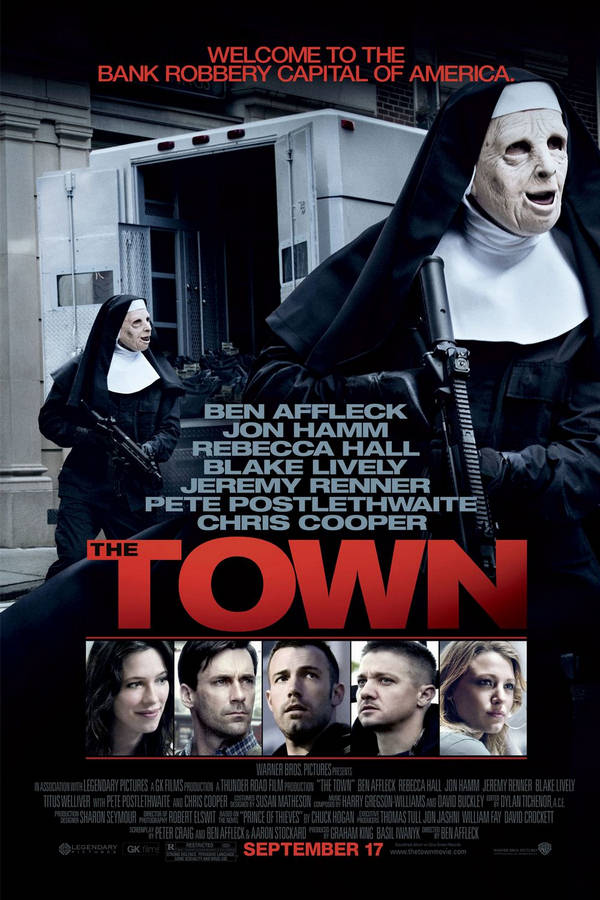
The Town

Full disclosure: Although I've never joined a fan club, written a celebrity a letter, or started a blog dedicated to my love for a boy band member, Ben Affleck is the closest thing I have to a life-long celebrity obsession. It's not even a romantic obsession. I don't doodle his name on my notebooks, and I think his wife is pretty freaking fantastic. But I feel deeply and personally invested in Affleck's success. Even back in his Bennifer days, when my much cooler cousins and friends would say things like, "Ben Affleck's only ever been good in one movie- Dazed and Confused because he was playing himself," I was secretely touting his performances in movies like Changing Lanes and Chasing Amy, and referencing his ease and intelligence on talk shows. When other people saw only a gambling, alcoholic pretty boy with capped teeth and expensive taste in jewelry, I was hooked on Project Greenlight and Dogma. So when 3 years ago Hollywoodland came out, followed closely by Affleck's fantastic directoral debut Gone Baby Gone, I felt a personal sense of "I Told You So!"

You might say, then, that I was meant to love The Town. On top of the previous Affleck-related prejudice, it was shot in Boston, so all the locales made me literally squirm in my seat with glee and nostalgia. It starred Affleck himself, plus the always delicious John Hamm (aka Don Draper). And it was a moody, occasionally funny thriller about dubious antiheroes. More or less Rachael catnip.

But that also means that I went in with absurdly high expectations. And The Town met every one of them. I was invested in the tale of Charlestowne bank robbers from the first violent seconds through the moody, beautiful finale.

Affleck directs with an ease and grit that one would have thought impossible from a guy whose only ever created two feature-lengthed films. On top of that, he puts in a career best performance as the "one last job" bank robber at the heart of the film.

There's not much in The Town that, on paper, exceeds the normal trappings of a heist film, but Affleck and his talented crew of actors never make a single second feel obligatory or cliched. There's a palpable energy and authenticity to the film that makes every second a thrill.

Thursday, August 5, 2010

Salt: predictable, badass and predictably badass

I'll keep this brief, there's not actually a lot to say about this film. The coolest thing about Salt is that the lead role was originally written for Tom Cruise and then tweaked to fit Angelina Jolie. The fact that a skinny chick like Jolie is in practice a hundred times more badass than Hollywood's erstwhile favourite action hero, is pretty darn cool. The film flies by, the stunts are great, the pacing perfect and the performances pretty decent. The story's okay, the effects impressive and the dialogue acceptable. In fact, Salt would be a truly awesome absurd summer movie if it weren't for one thing.

I've heard people complain that she should be dead within the first 10 minutes. I don't actually care about that fact at all. If we were looking at realistic survival statistics James Bond would never make it out of the scrapes he gets himself into. No, I'm all for bizarre heroics and feats of inhuman strength and cunning. My problem is predictability. Let's pretend for a minute that Liev Schreiber didn't accidentally let slip the big twist on The Daily Show (and desperately try to cover it up- to moderate success). I still think I could have seen it all coming

*** SPOILER LINE***

Of course Angelina's one of the good guys- she's the title character! They establish pretty quickly that she loved her civilian husband, we see her withstand torture for her country and she's clearly the most capable and smartest character in the cast. If anyone can think of an example in which such a character was anything BUT the good guy I'd certainly like to hear about it. In contrast, I don't recall ever having seen Liev Schreiber play a good guy. He's always duplicitous. Besides, he comes out of the gate all proclaimed national heroics and over the top personal loyalty- they set him up as perfect, and the perfect guy is NEVER perfect, especially if we hear more about his perfection than see it. Their good/evil flip could be seen a mile away by anyone even remotely familiar with Hollywood tradition. It was pure laziness in an otherwise enjoyably executed action movie. Angelina (just awesome enough to make up for being a little creepy) deserves better from a movie for which she agreed to dangle from a windowsill 11 stories up.

Tuesday, July 20, 2010

Inception: Part 2- Interpretation

But what the hell does it all mean?

SPOILER WARNING. I purposefully left my review vague, so you could read it without having seen the movie. No such promises will be made here>

It's understandable if you're left scratching your head at the end of Inception. I think you're meant to be. Nolan and co. leave it purposefully ambiguous, and I think that way you read the film is dependent on your personal world view. The way you read the film, by the way, can also help determine how much of a masterpiece you think it is - certain interpretations eliminate any potential plot holes, while others turn the whole film into plot holes. You might think this is because one interpretation is "right" while the others don't make sense, but I think Inception beggars that type of simplicity.

The film that Inception most recalls is, somewhat obviously, The Matrix. That is a movie similarly obsessed with playing with, exploring, and deconstructing our views on reality. However, unlike The Matrix, which played more to a philosophical crowd in between the intense action scenes, Inception isn't interested in name dropping established philosophies. It establishes its own world with its own rules, and more or less follows those rules in its pursuit of philosophical truth (I would argue that The Matrix, in contrast, synthesizes given philosophies and picks and chooses from those philosophies in its pursuit of truth). In this way, Inception is the more authentic exploration, since it never feels bogged down by the pretentiousness that eventually sunk The Matrix.

The film also recalls Nolan's own Memento, which plays with the ideas of the frailty of memory and reality, and with the mind's own desire to protect ourselves. Given the question of interpretation, I actually think this is the more telling comparison. For those of you who haven't seen it, Memento tells the story of Leonard, a man who loses his short term memory around the same time his wife is murdered. He spends the majority of the movie trying to track down his wife's killer, while dealing with the limitations of a disability that makes it impossible to understand his own interpretation of the universe around him. In the end, he can't even really trust himself.

The movie establishes a world where people can enter each others' minds and then leaves it at that. It never explains, nor should it. This is the universe we are asked to accept, and our acceptance hinges on the idea that the universe itself has a set of determined rules to be followed. Our ability to interpret this universe, therefore, is dependent on these rules and how accurately applied they are.

In Inception, our protagonist is Cobb (DiCaprio), an "extractor." Basically his job is to go into people's brains and take out their secrets, and as we are told he is one of the best in the business. The movie follows him as he attempts the opposite, namely inception, where he gives a person an idea. The movie's established rules for both extraction and inception are that once the brain realizes that a person or idea is false, it fights it off like a virus. Thus true inception is practically impossible, because the brain necessarily understands that the implanted idea is foreign and destroys it.

In theory that's the plot. It's the reason why Cobb gathers together his team (Gordon Levitt, Ellen Page, Tom Hardy, etc.) and it's the attempt to infiltrate Cillian Murphy's mind that drives the films action. However, the most exciting, frustrating and intriguing questions come up within Cobb's own story.

Cobb has a past, the uncovering of which is the actual fuel of the plot. To synthesize, Cobb was once married to Mal (Marion Cotilliard) and had two adorable children with her. They were both interested in exploring the potential of the dream technology. They pushed themselves too far, and ended up in limbo (a sort of purgatory for the dream-explorers, where time moves so slowly that you can live out decades of your existence and if you're not careful your brain can turn to mush), where they lived out a full life together. However, Cobb was always aware that this world was fake. Mal, on the other hand, hid that knowledge from herself, and therefore gave herself over fully to the dream world, losing her sense of reality and eliminating her ability to "kick" back to reality. In order to combat this (AND SUPER SPOILER WARNING COMING HERE), Cobb planted the idea in Mal's subconscious that her reality was fake. This is how he knows inception is possible. It also, however, is how he knows how dangerous this all is.

See, once Cobb and Mal got back to "reality" (and again, this is all open to interpretation), Mal still had this idea in her subconscious that her reality was inherently fake and that the only way to escape was to die. So she killed herself, begging Cobb to follow her to freedom. Cobb, tied to reality by way of his children, refused, and she framed him for her murder. Cobb then fled the country, and became a dream thief, desperately trying to get back to his kids. He's in this state when Ken Wattanabe's businessman, Saito, approaches him to try out Inception on Cillian Murphy. But he's haunted by the "ghost" of Mal, who foils his attempts at both thievery and inception, and constantly reminds him of his own guilt and causes him to question his own sanity. On top of this, he's no longer capable of normal dreaming, and builds himself a nightmare dreamscape where he is trapped with nothing but his regrets.

That is all more or less straight forward. Sort of. But what exactly is reality? Where do Cobb's dreams, or Murphy's dreams, or Saito's dreams end, and true reality begins? Your answer to these questions depends on your own personal viewpoint. Cinematical.com has a fascinating study of 6 different interpretations, but curiously it ignores my personal favorite, which I will elaborate here. If you want to read the other six, follow it here

My theory is thus: I take the movie at its word. That is to say, when Cobb decides something is reality (up until the very last scene) I agree that it is. They are in reality when they take the job from Wattanabe, and they are in the dreamscape once they plug in with Murphy on the plane. Maybe this is a simplistic viewing, but in my opinion it works just as well as the "it's all a dream" argument. If you follow the movie by its own admissions, then the only question left is the ending.

Throughout the film, DiCaprio's totem remains a visual link between reality and dreaming. The ending of the film is left intentionally ambiguous as to whether or not the totem is going to fall. With my theory, our interpretation of the ending tells us if we're a pessimist or an optimist. Do you believe that Cobb escapes and gets back to his children, or do you believe he's still trapped in limbo?

Personally, I think he's in limbo. I've got some evidence. For one, his kids didn't age, and they happen to be wearing the exact same thing they were in his memory. For another, how did his father even know to pick him up at the airport? Third, why exactly didn't he age when Wattanabe did?

After reading the cinematical piece, I found myself buying the whole "it was all a dream" narrative far more than I did while watching the film. However... it kind of doesn't matter. The point is the questioning. In film school, they made me watch a bunch of infuriating non-narrative films that were all about the experience and the subconscious. There was no logic to be followed in these films, no secret narrative to be uncovered. In a way, Inception is a non-narrative film wrapped in narrative, and uncoiling those layers is the process that gives the film meaning and eventually leads us to the catharsis that Nolan wants from us, regardless of our interpretation.

Inception: Part 1- Review

By Rachael

I think that in talking about Inception, you can do one of two things. First, you can analyze what the film means - what was Nolan saying, what does his world consist of, does it make sense? Second, you can actually talk about whether or not it was a good movie. I'm not saying the two parts are unrelated, nor am I arguing that one is more valid than the other. My point is merely that in a movie like Inception, I think the interpretation has less to do with whether or not it's a film worth watching and praising and more to do with the fascination that lingers after the film is over.

As such, I plan on writing TWO articles about Inception, which may be self-indulgent of me, but I think is the most authentic way to talk about this challenging, fascinating film. As such, this article is not interested in the "What does it all mean?" questions, but rather the most basic question of film reviewing, namely, "Was it a good movie*?"

My answer to this question is an unequivocal yes. Leaving aside all questions of interpretation, tempting though it may be to indulge in them here, Christopher Nolan's mind fuck of a film is still a masterpiece of epic proportions. The visual landscape alone, from the soaring metropolis's that make up the filmmaker's playground to the intimate dreamscapes, is cause for celebration. The artistry of the fight scenes, especially those starring the fantastic Joseph Gordon Levitt, is as revolutionary as any since (and we'll talk about this A LOT more in my interpretation) The Matrix.

Leonardo diCaprio brings his usual controlled chaos to his role as the central figure navigating someone else's subconscious. It's a role he's almost getting too comfortable in (as a huge fan of diCaprio, I don't want him to get stuck into one rut so early into his career, no matter how meaty the rut), but you can't deny that he's great in it. As for the rest of the motley crew of dream-jumpers, Joseph Gordon Levitt and Tom Hardy stand out, not just for their inherent badassitude, but also for bringing some much needed levity to some of the film's heavier moments.

The story is fascinating. Whatever your interpretation, you can't say that Nolan makes boring films. For a man who's films have grossed well over a billion dollars, there's nothing superficial about Nolan. He's asking big questions, and making bold cinematic statements. He challenges the typical notions of films, and has a visual artistry that is nothing short of profound.

Not to put it in too soaring and dramatic terms, because honestly I'm put off by all the "it's the greatest movie ever" gushing, but Inception marks a high point in the career of a man who has seemed to have nothing but high points. It represents a culmination (I refuse to say "the culmination" because I'd like to think Nolan has a lot more to show us) of the journey that Nolan started in Memento, a journey he continued through both of his batman films as well as his smaller pictures like Insomnia and The Prestige.

This is a man deeply interested in exploring reality, both cinematic and actual. And Inception is a film obsessed with these metaphysical concepts, yet grounded enough in reality that it makes the whole thing gripping and fascinating.

*Please don't conflate basic with simple. What makes a good movie is the basic question reviewers have been trying to figure out for years.

Friday, July 2, 2010

The Case for Simplicity

Tom Cruise is very good at stunts. He runs fast, shoots well, can dangle from a building, throw himself into things and generally leap and fling about heroically. He's also charming, can hold the camera's focus and deliver a line effectively. He's quirky, can play interesting characters and instantly earns the audience's trust, even if most of them adamantly believe him to be a crazy person (a belief I don't fully subscribe to but understand the foundations for). Cameron Diaz, though never a favourite of mine (except in My Best Friend's Wedding, she's adorable in that), is similarly charming and capable. Paul Dano is one of the best young actors of his generation, delivering standout performances in some of the most acclaimed films of the decade. Viola Davis has 2 Tonys, 2 Drama Desk awards and an Oscar nomination to her name. Peter Sarsgaard is basically a god of complexly layered characters. Knight and Day had a basically solid script with strong backstory, decent characters, an engaging conflict and good pacing. The components were there for it to be a not-too-guilty summer pleasure movie. It seemed destined for action-comedy triumph.

So why is it so darn bad?

The answer is one word, and one word only: EFFECTS.

Knight and Day is brimming with action sequences so over complicated that it'll make your head spin. It takes you all over the world, into situations the story doesn't require or support and on more motorcycle and classic car rides than you can shake a stick at. But we may as well have been in the 1970s for all the technological sophistication in this film. They had an actor with more stunt experience than almost any other and yet couldn't just let him do his thing. A couple simple shootouts, a well-shot explosion here and there, some cleverly choreographed fights and maybe one chase scene (done properly, with actual chasing) was all the film needed to fulfill the action requirement in its action-comedy definition. But no, for some reason, a motorcycle ride through the running of the bulls was somehow deemed mandatory. So instead of a cleverly fun film featuring some truly engaging talent, we got a distractingly over-ambitious romp that looked like it was made at a local access channel using the weatherman's green screen.

There are few things more aggravating than a movie that could have been decent destroyed by a single department, and in the case of Knight and Day, the blame lies entirely with the special effects guys.