Friday, December 17, 2010
Blood and Guts and Sheer Will
There are two superstars who really make 127 Hours what it is (aside, obviously, from Aron Ralston, the real life protagonist whose memoir the film recounts): director Danny Boyle and star James Franco.
The film has very little story to tell before and after Ralston is trapped by a bolder in a canyon, that means for maybe 80% of the film's 94 minutes, all Boyle had to work with is a rock, a hard place, one guy and a rucksack. So that's what he uses. Boyle creates the horrifying reality of Ralston's shrinking world brilliantly using a video camera as his Wilson-of-sorts (to invoke the same comparison as every other reviewer out there) and his dwindling supplies as a representational countdown. As Ralston goes without sleep, runs out of water and generally begins to slip away from reality, Boyle creates a colourful dreamworld of memories and delusions for both Ralston and the audience to escape to in avoidance of the treacherous reality. Visually stunning and directed with great pathos, 127 Hours is a directorial tour de force from Danny Boyle.
And speaking of tour de force, if there was ever a part for a guy like James Franco to really bite into its this one. A talented if eccentric actor, Franco's perhaps the least predictable project picker in Hollywood. But thank god he picked this one, because I can't imagine anyone else playing it quite so well. Armed with an elusive sort of charm, Franco perfectly captures the essence of a man who could easily slip into a fun afternoon of adventure with a couple of girls he meets in the middle of nowhere then turn around and seek out absolute solitude.
From the moment that rock slides into place trapping him, to the moment he torturously frees himself by cutting off his arm, Franco commands the camera effortlessly, alone. His panic, sadness, hysteria and desperate humour lead the audience through a tumultuous psychological journey right alongside him. The moment when he demands of himself that he not lose it is truly unbelievable. The small details of survival- the careful rationing of a single canteen of water, the painful moistening of hardened contact lenses- are the worst, they make the dull ache of time passing leading up to the final (and now infamous) amputation so unbearable that you're rooting for freedom at any cost.
Ultimately, in spite of the blood and gore and horribly unpleasant slow walk towards death-ness, 127 Hours is the most triumphant movie I've seen in quite some time. It's about survival and the amazing things that we're capable of, even when (or especially when) literally trapped between a rock and a hard place. It's the story of a remarkable man told by two remarkable artists. I walked out of that theatre and saw a slightly different world. In his 127 hours of captivity, Ralston lived for the 15 minutes of sunlight he got each morning. The privilege of walking out of that theatre, pinned down by nothing, with all of my limbs and the ability to feel the sunlight on my face felt like such a remarkable gift. It's a powerful film that changes the way you see the world, even just temporarily. 127 Hours is nothing if not inspiring. It's a story about the power of will, a tribute to a man who decided he was going to be okay; he decided to live, and so he did. What a concept.
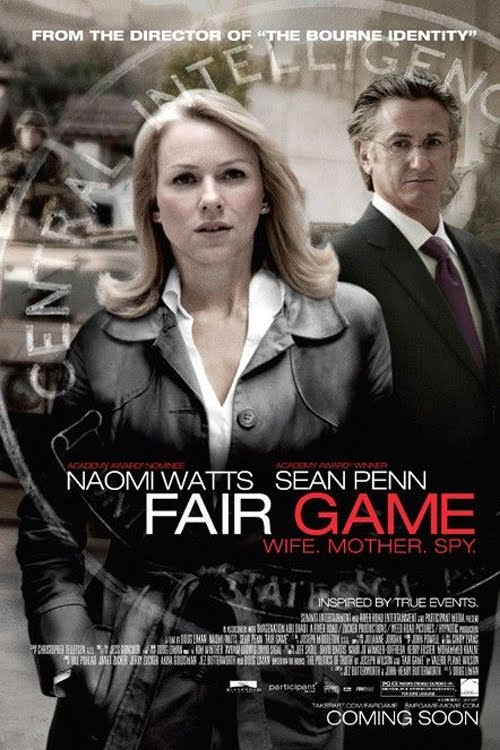
Fair Game
But it was just okay.
It was fine. It was interesting at times but not quite as interesting as it should have been. It was engaging at times but never quite as engaging as it should have been. My feelings about Fair Game can basically be summed up in the fact that my favourite parts were 2 sequences where Valerie and Joe had dinner with their friends (played by such wonderful people as Norbert Leo Butz, Ty Burrell, Brooke Smith and Jessica Hecht- seriously, at about 2 lines each this was a strangely all-star cast). It was in these brief scenes that my interest was really peaked- dinner party chatter. Casual political debate that never remains casual, the dichotomy of the decently informed citizen and the actual insider- that's where the issues lived, in the difference between what's true and what smart people are allowed to know. That was the best part of the movie- the periphery friends who don't know what they're talking about.
Joaquin Phoenix Is, in fact, Still Here
Needless to say, in less than 2 hours, Phoenix managed to make me completely reverse my opinion on his behaviour. Without the lens of the tabloids in front of it, I started to believe in his breakdown.
I came out of that theatre infuriated. I was mad at Phoenix for allowing himself to fall off a cliff, essentially robbing the world of one of his generation's greatest acting talents (his performance in Gladiator is, to this day, one of my all-time favourites). I was mad at Casey Affleck for exploiting his descent. But mostly, I was mad at Phoenix's friends for not bothering to catch him. Or "friends" rather. It was their job to at least try and help him; if your friend is headed for disaster, blindly agreeing with them does no one any good- you have to call them on their crap, straighten them out, essentially, don't let Lear banish Cordelia without taking a moment to play Kent. Interestingly, Sean "Puffy" Combs is somewhat of a rare good influence in the film, supporting Phoenix while trying a little bit to break his delusion. There's also one friend, Anton, who stands up to the raging Phoenix, but by the time he does, the man is so far down the rabbit hole that he's doing little more than saving himself by rebelling. In the film, Phoenix is surrounded by people, all the time, and doesn't have a soul to lean on.
As viewers, we aren't guilt-free either. As I sat there in the theatre, I remembered giggling gleefully at the awkwardness of Phoenix's infamous Letterman interview. I remembered thinking the talk show host was so clever as he poked fun at his despondent guest, making the "best" of the botched interview. But I'm Still Here offers the audience the 2 minutes after Letterman wraps. Phoenix stumbles backstage, terrified. He doesn't cry, he doesn't scream (the desperate tantrum comes later), he just stares and quietly swears, defeated. That moment made me cry, for the trampled Phoenix, for his promising career, for my ridiculous self, plagued with guilt over having once laughed alongside the bully beating a beaten Phoenix further down. That incredibly human scene of a trapped man desperate to pull himself out of a hole and not sure how, that's what had me convinced it was all true. I didn't think he could fake that.
But he could. Of course he could. If I'd really thought about it, and maybe stopped to remember Gladiator during one of those many hard-to-watch sequences involving cocaine and hookers, I'd have known Phoenix could fake that. He's really good. REALLY good. I think that's what we all managed to forget in the past 2 years, when this supposed "meltdown" was playing out in the tabloids (and I abandoned as soon as the film's disturbing images began to take priority). It's amazing how quickly the world can abandon a truly phenomenal talent when we deem them "weird". It wasn't just his terrible friends who refused to help Phoenix, it was everyone- the media, the audience, the industry (except, it seems, Puff Daddy), who'd rather laugh at him than try and get him back.
In essence, Phoenix presented as a man uncomfortable in his own skin, horrified by the box Hollywood had put him in and unsure how to deal with the world pressing in on him. Hoisted on the shoulders of the tragically long list of brilliant artists who've had an honest-to-god fatal fall because of these same issues, I'm Still Here brings up all sorts of depressing thoughts of Heath Ledger, Michael Jackson, Kurt Cobain, and even Phoenix's own brother River. It truly was the performance of a lifetime, but apart from that, I'm Still Here is a searing mirror help up to our glib, unforgiving faces. It takes our absurd relationship to celebrity, flips it on its head and threatens us with the consequences of the way we are. Phoenix and Affleck's "documentary" is convincing, horrifying, and the fact that it isn't true makes it no less right.
Tuesday, December 14, 2010
'Tis the Season... Installment 7 Halloweentowne Edition
I'm sure I've seen The Nightmare Before Christmas at least three or four times in my lifetime, yet it's never been one of my Christmas movies. I think maybe I seceded it to the goth kids shopping at Hot Topics in high school, and just never bothered to take it back.
So it is that watching The Nightmare Before Christmas as a (semi) adult, it felt almost like the first viewing. In fact, the closest thing I can compare it to is watching Casablanca for the first time and feeling that vague sensation of deja vu even though you know you've never actually seen Humphrey Bogart's face before.
It's worth it to remember just how revolutionary this movie was when it first came out. In a way, Tim Burton was perverting the claymation magic of Rudolph and Frosty and the other classics of the stilted absurdist medium to make his Halloween-ified Christmas movie. Now it seems almost cliched to see the love interest with her stitched up mouth, and Jack's elongated skeleton frame dancing through the screen, but back when this movie came out it was pretty new and different.
And yet The Nightmare Before Christmas is really the most classic of holiday movies: one that grapples with the meaning of Christmas, especially since most of us don't forever live in Christmastowne. It's protagonist, Jack, is the king of Halloweentown (in a metaphorical sense), a man who has made his fortune and reputation on scares and danger. He becomes obsessed with the glee and happiness he briefly glimpses in Christmastowne and looks to bring it back to the cold dreariness of his Halloween world. Unfortunately, as he attempts to apply the scientific method to the study of Christmas, he horribly misjudges the meaning and attempts to take Christmas and pervert it to the world of perpetual All Hallows Eve.
When Jack realizes his mistake and starts to grasp the true meaning of Christmas, he still has to contend with the evil Oogie Boogie in order to save Christmas. It's a classic Christmas adventure made all the more moving and intriguing for its imagery of vampires and werewolves (working together? Now that IS Christmas magic!). For Jack, Christmas is ultimately a time for him to exceed the supposed limits of his life and to realize his dreams, as long as he doesn't hurt anyone else in the process (such as the poor, mistakenly kidnapped Easter Bunny).
A Nightmare Before Christmas is a movie that is simultaneously dated and timeless. The visuals are still pretty impressive (if not quite as unique), but it's really the stories and the endlessly catchy songs that make it worthwhile.
Monday, December 13, 2010
Thor?
I am a comic book nerd, and a huge fan of movie adaptations of same, and yet the Thor movie (even with Kenneth Brannagh in the director's chair and Kirk's daddy playing the man himself) never really sparked my interest. But even my apathy couldn't survive this surprisingly intriguing trailer, which manages to even make that freaking helmet look less-than-goofy.
(I wanted to embed the trailer, but it wouldn't let me do any of the decent quality ones, so just grab this link to check it out in glorious HD)Sunday, December 5, 2010
'Tis The Season ... Installment 6 Holiday Violence Edition
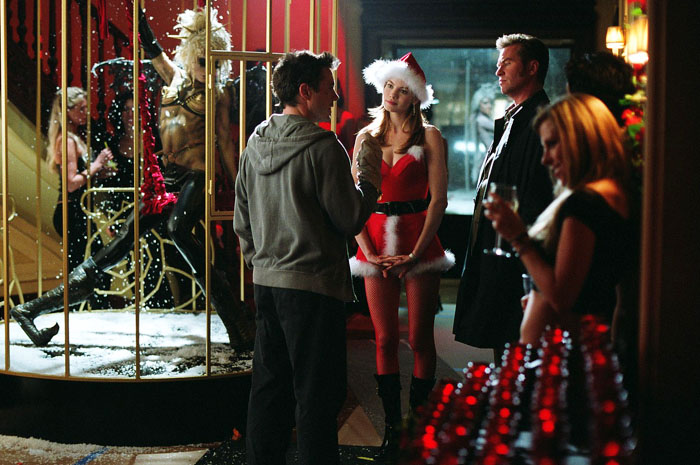
It's written and directed by Shane Black, who made a big name for himself in the 80s when he wrote movies like The Long Kiss Goodnight and Leathal Weapon, and practically held the patent on witty action movies. And it's even funnier and actionier than those credits would imply.
Robert Downey Jr. is in his element as a the dull-witted, fast talking unlikely action hero and Val Kilmer is legitimately better than he's ever been as Gay Perry (the private detective consultant working with Downey). Michelle Monaghan as the struggling actress love interest is fantastic, the perfect mixture of old school noir sexy and new school neurotic.
But this isn't a movie review - it's a Christmas movie review. And what makes Kiss Kiss Bang Bang such a great Christmas movie?
At their hearts, Christmas movies are about the sadness of life mixed with the hope that the annual family get together can somehow change the course of your life. In Kiss Kiss Bang Bang Robert Downey Jr. meets up with his childhood sweetheart (his version of family) and suddenly the same downward spiral that has characterized Harry's life thus far is broken.
The combination of film noir, Christmas absurdity, and post-modern verbal diarrhea turns into something uplifting, amusing and surprisingly wholesome for a movie with lots of boob-shots and casual f-bombs.
Plus it's gosh darn hilarious.
Exhibit A:
Perry: Look up the word idiot in the dictionary. You know what you'll see?
Harry: a picture of me?
Perry: No. The definition of the word idiot, which is what you are!
Exhibit B:
Harry: Man I feel sore. I mean physically, not like a guy who's angry in a 50s movie."
'Tis The Season... Installment 5
The Holiday, in many ways, is exactly what people are complaining about when they bemoan the death of the modern romantic comedy. It is about to unlucky in love women who swap houses for the Christmas holiday and subsequently meet new men and have their lives change. Along the way, the women flop about, drink too much, monologue their feelings out loud, and generally make a fool of themselves.
On another hand, The Holiday is also what people think of when they think of a bad Christmas movie. IT takes the Christmas holiday and uses it to elevate an otherwise unremarkable romantic comedy. The movie has nothing profound to say about Christmas, or innocence, or religion, it merely uses the green and red background to inspire in its viewers a sense of homey nostalgia.
And yet... I sort of love it. You've got Cameron Diaz doing what she does best (sassy girls doing goofy physical comedy), Jude Law at his smarmy English best, and Jack Black giving the most understated and endearing performance of his career. Kate Winslet, as Iris, is certainly good-enough, but in a career like Kate's it's hard to really take note.
On top of that, the characters are surprisingly sharp and interesting, and the dialogue good enough and snappy enough to allow the actors to show off their talents. It's in many ways a lowest-common-denominator movie, but made well enough that you can enjoy the Christmas-coated fuzziness of a movie that also includes not just a wise-beyond-her-years-motherless-daughter but ALSO a wise-as-is-appropriate-to-his-years-grumpy-old-man.
Thursday, December 2, 2010
'Tis The Season... Installment 4 Slightly Dubious Double Feature
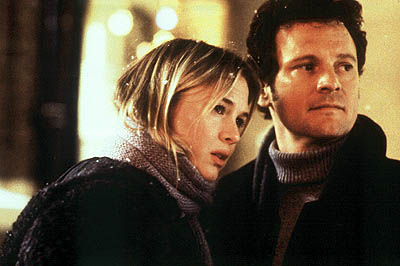
The first of these two was one of my all time favorite "guilty pleasure" movies, Bridget Jones's Diary. The tale of perenial singleton Jones, manipulative but sexy Daniel Cleaver, and dream boat Mark Darcy has brought many a-chuckles to single ladies the world over. But it's the iconic drinking-alone-set-to-"All-by-Myself"-at-Christmas scene that has always stuck with me. That plus the Christmas sweater that is Mark Darcy's introduction has always steeped Jones in christmas depression and hope simultaneously.
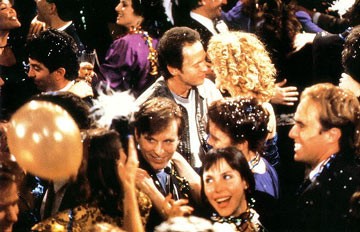
The second of my abnormal Christmas movies is When Harry Met Sally, a movie bookended by bittersweet New Years Celebrations, also makes my Christmas list. Despite the fact that the movie spans years (and therefore certainly has a scope bigger than just the Holiday season), it's the sense of occasion and romance that elevates some of the biggest moments.
I know that neither movie is really a Christmas movie - neither features a major subplot involving Santa Claus nor an adorable little girl who has her faith in humanity reaffirmed, but they both use the context of the holidays to heighten their characters emotional distress and draw them towards act of over-the-top romance. And they ultimately put me in the right seasonal mood, full of hope and occasion.
Wednesday, December 1, 2010
'Tis The Season ... Installment 3: Slightly off-putting family drama edition
Posted by Rachael
So far I've dealt only with Christmas movies that I've loved. This installment is one that kind of takes me aback a little bit when I watch it: The Family Stone.
If you don't remember The Family Stone, or if it doesnt grace your beloved Christmas-movies list, I don't blame ya. It came out in 2005, and with its cast of highly-marketable and diverse actors, was marketed as a wacky family comedy about bringing the girlfriend home to the parents. Maybe you remember it? Check out the trailer below:
See? It's kooky holiday fun! And with its cast of Diane Keaton, Sarah Jessica Parker, Claire Danes, Rachel McAdams, Dermot Mulroney, Craig T. Nelson and Luke Wilson, and a plot description on IMDB that reads like a wacky Meet-the-Parents-meets-Christmas rip off*, I remember settling into a movie filled with wacky, messy hijinks and christmas-time nostalgia.
What you get when you watch The Family Stone is something massively different. It is in fact a much more heart felt dramedy, dealing with the ramifications of growing up, becoming your own person, and losing your parents, of all things, and very deftly uses the Christmas holiday as an excuse to bring together a family of loving individuals who don't really know how to fully deal with each other as adults. They're kooky, I guess, but mostly they're just normal people dealing with the same stuff all of us do when we go home. They meet up with relatives who they see maybe once or twice a year, and are dealing with the fascinating contrast between loving these people unconditionally and not quite knowing how to interact with them.
Add to that the (SPOILER ALERT) rather shocking plot involving Diane Keaton's inoperable breast cancer and each of her children finding out (on Christmas!) that their mother probably won't be around next Christmas, and you certainly don't have a Robert Deniro/Ben Stiller farce on your hands. And so the first time I watched The Family Stone, I had absolutely no idea how to take it.
But in rewatching it this Christmas as part of me ongoing attempt to chronicle every step of the Christmas experience, I was amazed with how fascinating a film it is. At times unwatchable for how unlikeable it allows Sarah Jessica Parker's character to be, and at others profound for how much it recognizes the absurdities of every day life, The Family Stone is almost the perfect antidote to normal Christmas fare. It knows that Christmas doesn't magically fix everything (there's no comforting ending montage, as their is in Love, Actually, meant to make us believe that everyone's lives were happier after than before), while still trying desperately to believe in the magic of Christmas and of the familial connections that make Christmas worthwhile.
Of course, there's also an absurd sibling-switching storyline, and a good amount of food getting accidentally onto people's clothes, so it's far from a perfect movie. But viewed in the right context (and with the right amount of hot chocolate mixed with peppermint schnapps), it's a fascinating offset for the sugary likes of Elf.
* The actual, and completely inaccurate, description:"An uptight, conservative business woman accompanies her boyfriend to his eccentric and outgoing family's annual holiday celebration and finds that she's a fish out of water in their free spirited way of life."
Monday, November 29, 2010
'Tis The Season... Installment 2
The second movie in our holiday-viewing docket is Elf, another new classic. At once heartfelt and hilarious, Elf consciously conjures up a childish sense of wonder while playing to an audience that ranges from the littlest tykes to middle aged Will Ferrell fans.
The story of Buddy the 6+ ft elf is a unique one within the Christmas movie pantheon: Buddy was abandoned as an orphan, accidentally stowed away on a bag to the North Pole, and was raised among Santa and his toy making ilk. When he grows up to be Will Ferrell, his ungainly size and general non-elfness make him realize what he should have known all along: he's not an elf, he's a human, and he has a non-elfen father on the Naughty List in New York City.
After a fantastic sequence in which Will Ferrell wanders through a claymation version of the North Pole in a nod to classic Christmas fare, Buddy makes it to NYC, where he's just as much of a misfit among the work-a-day cynics who populate there. He works at Gimbels, befriends his fellow "elf" (a disarmingly blond Zooey Deschanel) and worms his way into his father's family's hearts, despite the fact that he seems like a tights-wearing psychopath. But when the general lack-of-belief causes Santa to crash land in the middle of Central Park, everyone's belief is really put to the test.
In the end, Elf is more about how much fun it is to be a kid than it is even about Christmas. It uses the santa metaphor to make the popular argument that strangling our inner child probably isn't the best way to go through life. It's Will Ferrell's complete conviction with this idea that makes Elf so much fun. It's a gleeful film, filled with moments, both tiny and oversized, of hilarity.
Sunday, November 28, 2010
Tangled Up
I have a confession to make. Despite years of soccer-playing, action-figure-collecting, comic-book-reading, action-movie-loving tomboy-ery, I've always, truly, wanted to be a Disney princess. But I didn't want to be just any princess: I wanted to be Belle, the confident heroine who ultimately saves herself and her love with her brains and good heart.
This is hardly a unique statement. Generations upon generations of girls the world over have day dreamed about being a disney princess. But it's the neccessary context around which to understand my reaction to Disney's Tangled.
The newest Disney film follows Rapunzel (Mandy Moore) and Flynn (Zachary Levi) as they evade a wicked wit, uh Old Lady, chase their dreams, banter, interact with adorable anthropomorphized animals, and, inevitably, fall in love. It was cliched before Enchanted came out and set it in the real world, but it definitely feels worn in this hour of post-modern Shrek-ery and Pixar films.
But god damn. That so doesn't matter. The beauty of a true Disney film is not in the shocks of the plot (although Tangled is an excellently constructed story), but in the magic that floats off the screen. The animation is top-notch, the voice work across the board excellent, and the songs (as drafted by Disney vet Alan Menken) are fantastic.
top of that, Rapunzel is a heroine for the ages. The movie feels at once classic (there's no meta-winks at the camera, no irony to be found here) and modern (yet the film doesn't feel the need to relegate Rapunzel to a pre-Mulan damsel in distress mode). As voiced by Moore, she's spunky, intelligent, innocent, engaging, and active, constantly working towards her own freedom and her own happy ending. If the feminist in me has always had a sort of love-hate relationship with the princess side of me, both sides happily coexisted while I was in that theater.
A lot of reviews I've read feel the need to explain now what Tangled isn't (oscar-worthy, a Pixar film, going to cure cancer), as if the reviewer feels a little ashamed of how much they fell in love while in that movie theater. But screw it. If my life was the Disney movie I wish it was, then walking out of that theater I was in full blown ballad-mode, and not the beginning, heart-felt longing ballad, but the near end of movie I'm so happy my head could burst ballad. And if that's all a movie has to give me, I feel no need to appologize for my adoration of it.
Disney recently announced that Tangled is the last of their princess movies, and seeing the film made me realize what a shame that truly is. It isn't just the songs or the pretty dresses or the cute animals; it's the princesses themselves who, when done right, are much better than just future dolls, they're the fully-realized version of who we wish we were. and as long as the princesses are as fantastic and interesting as Rapunzel, that's a good thing.
Saturday, November 27, 2010
'Tis the Season...
The "Holiday" season has never really begun for me until I allow myself to slip into the pop culture cocoon of movies, tv shows, and music specifically designed to activate the heart tingling part of us all that wants to give ourselves over to childish optimism. And nothing is quite as essential as the Holiday movie parade, those classics and not-so-classics of the silver screen that annually grace my home theater in the hopes of capturing some christmas joy.
I have a lot of Christmas movies, so this year I'm going to chronicle my way through them as I watch them. Christmas is a process for this half-jewish girl, that starts the day after Thanksgiving on my mother's couch and ends on Christmas night at the movie theater. In between is a cornucopia of different films, in varying degrees of quality and belovedness.
The first movie on this year's docket is Love, Actually. It's purposefully a "new" classic. It's one of those movies that I have legitimately watched over 15 times and it never really gets old.
It's not that I think Love, Actually is one of the best movies of all time, or even the best Christmas movie of all time, although I do think that sometimes people refuse to see the excellent movie beneath the cliches. But the real reason why Love Actually makes this list is because of that the delightful mixture of old fashioned optimism with sometimes uncomfortable levels of reality that somehow makes Love Actually one of the most uplifting and hopeful movies of all time.
On top of that, it is a movie drenched in the popular culture infused wrappings of modern day Christmas, where pop songs and movies coexist with nativity plays at schools and private celebrations at home. It's love is hard won, whether its the midlife itch of Alan Rickman or the brotherly love that is all that's left for Laura Linney. And if at the end you're not singing along with Uncle Billy as he croons, "So if you really love Christmas, come on and let it snow," then you're probably a grinch. Or possibly Jewish.
Wednesday, November 24, 2010
...And The Deathly Hallows
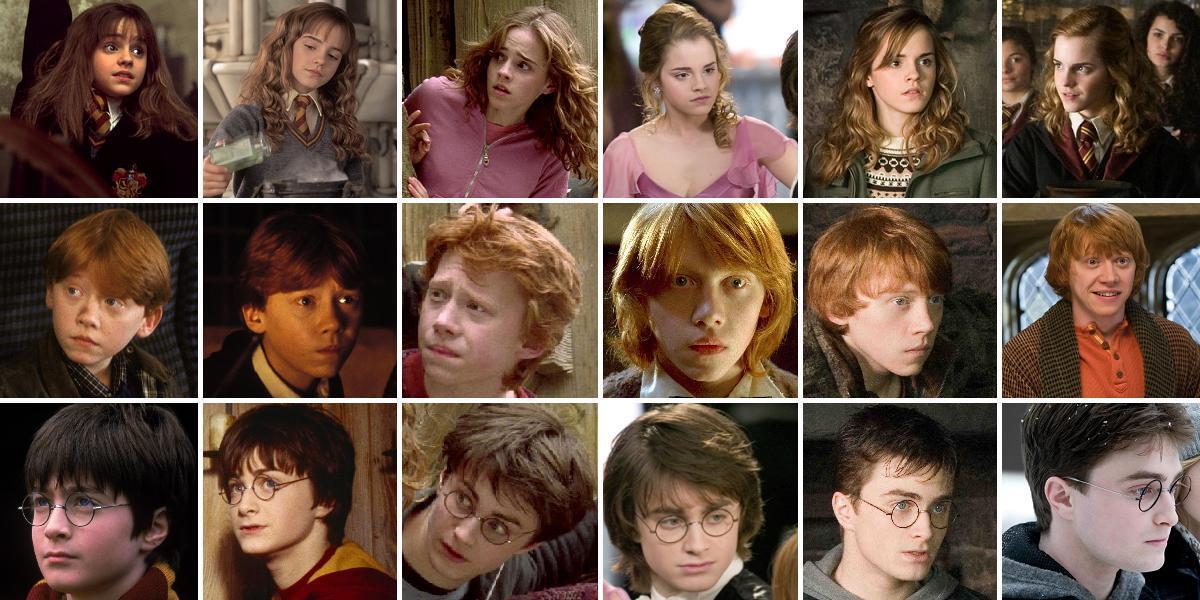
If I were to remake the list below, Deathly Hallows would easily and handily fall at number 1. It wouldn't even be a debate. Let's just get this out of the way, right here: to me, Harry Potter and the Deathly Hallows was easily the best film of the series, the best adaptation of a Potter book, and one of the best films of this year.
In a lot of ways, DH represented the perfect melding of book and movie. Freed from the crunching time constraints that the last four books have had to deal with, and with a fanbase that have almost all aged out of tweendom and strongly into "legitimate adult audience" world, Deathly Hallows is, appropriately, the most adult and compelling of the films.
I'm going to attempt not to conflate the book's excellence with the movie's own excellence. Of course Deathly Hallows tells a deeply fulfilling and appropriate story: we already read the damn book. JK Rowling's concluding chapter was a masterpiece of devotion to theme and character and the culmination of years of effort. But the movie lives up to this standard by taking the excellent material laid down and making it come to life cinematically.
As directed by David Yates, far less of the Harry Potter emotional journey is spelled out than ever before. The characters are going through some of the most intense emotions they've ever felt, but gone are the days when they will, child-like, spit it all out at the camera. Yates has such faith in his actors and audience that finally the series lets subtext remain subtext. You don't need to be told every detail of what's going on. We don't need Harry, Ron or Hermione to ever monologue about how weird it feels knowing the whole fate of the wizarding world lies on their shoulder, or how much more serious the danger is in this installment. In true cinematic form, we can tell from the imagery (Hermione's hands caked in Ron's blood, the casual death of a Hogwarts professor, Harry and Hermione's make out scene) and from the quiet moments (like Hermione's thoughtful line as the trio stands alone in Grimmauld Place, "We're alone.").
The way you can really tell that this is an excellent adaptation of the books is in the stuff that it just plain makes up. From the first shot of Hermione wiping her parents memory to protect them (which is mentioned in the book but not shown), you can tell that Yates and Kloves understands exactly what this means and they're counting on you to get it too. And damn if Emma Watson isn't knocking it out of the park, showing both Hermione's steely, bad-ass determination and how much it deeply hurts her to have to do this to her parents at the ripe old age of 17.
Or take the oft-discussed tent scene. It takes place right after Ron has (spoiler alert) left Hermione and Harry in a fit of horcrux-and-jealousy-induced rage. Hermione has been a vacant mess. Harry, being a good friend, starts goofy dancing with her to cheer her up. But they're also to mature individuals who are stuck in a bleak, cold world with little help, and there's a tiny moment between the two where it almost seems like this is going to a very non-canonical place. The ultimate decision by both characters to realize what their relationship really is therefore seems both more honest and more profound for the movie having gone to a place that the book never had to. It's both true to these characters and completely fabricated, and it provides a very vivid portrait of both the grace and realisticness of Harry and Hermione.
The fact that the added details feel perfectly in place is the greatest indicator that this movie, even more than any of the other films, gets what made the books worth it.
I could write a book full of praise for the main three's acting in this film. Gone are the days of awkward line readings, forced emoting, and eyebrow acting. All three main stars have blossomed into something fantastic. But if I had to give an award for best performance, it'd go to Emma Watson, hands down. I've mocked the girl who took my role for years. She was the weakest link for a while. But Watson provides such a painful, quiet, deeply flawed and wounded and yet strong and badass performance as Hermione that it made me love one of my favorite characters of all time even more for having seen it. There's another tent-scene, where Hermione slips back into her old school-girl esque habits ("Actually, I'm highly logical...") in which you can really tell just how far Watson has come from the old "Wingardium LeviOsa" days.
Some people are claiming the movie feels like only half a film, or is somehow unsatisfying, and I guess I can understand that, but for me, Deathly Hallows was everything it needed to be and more, and a beautiful testament to why it's worth it to adapt beloved books to film.
Harry Potter, the book and movie series, hasbeen such a profound part of my life for so long that the discovery of new levels of enthusiasm was a pleasant and fantastic surprise. The reason why it's ever worth the effort to adapt a book to a movie is not just to make money but, in a movie like Deathly Hallows, its the pure unadulterated joy that can come from watching a new work of art being spun from something amazing to begin with.
Harry Potter: A History*
In other words, this is a post about the history of the Harry Potter film series, as I see it. Up front, keep in mind that I am a rabid, if not super-rabid, Harry Potter fan, who has shown up for the midnight release party of the last three book, and who received her first copy of Harry Potter at the tender age of 11. It is an understatement to say that this series has been a huge part of my life.
However, I was also a film major. That's not to say how fancy-pants I am, nor say that I am inherently more qualified to judge films, merely to point out that I have often been able to let my fan ardency for exactitude fade to a quiet whisper while watching a Harry Potter film (as will become abundantly obvious in the following list). So without further ado, here's my top six pre-Hallows Harry Potter films, in order from least-beloved to most.
6. Harry Potter and the Sorcerer's Stone- In an overly pithy sentence, it's as though the book version of Harry Potter has cast a "petrifiucs totallus" spell on the movie's first installment. With unoriginal direction by Chris Columbus, and combined with an over adherence with the book's minutiae, the Sorcerer's Stone completely fails to capture the magic of Harry Potter that has kept fans enchanted for so many years. Movies and books are inherently different mediums, and adapting one to the other requires more than just cutting stuff out for time- it requires a complete transfiguration.
5. Harry Potter and the Chamber of Secrets- The same issues plagued the second film, although the danger of the Chamber of Secrets somewhat ups the stakes for this one and makes it a little more engaging.
4. Harry Potter and the Order of the Phoenix - There's not much to say about Order of the Phoenix. It takes the longest book and makes the shortest movie. Along the way, a lot is lost. This is good (even JK Rowling claims the books to damn sprawling and could probably use a good weed whacker editing job) but it makes it a less satisfying adaptation. I remember seeing it for the first time and kind of feeling as though I'd just watched a montage of important Harry Potter moments rather than one cohesive film.
3. Harry Potter and the Goblet of Fire - Goblet of Fire was probably the most cinematic of the books. It tells a straight forward adventure tale of a too-young boy entered into a dangerous contest, and it has a natural ebb and flow along the lines of the three challenges that makes it really easy to transcribe to film. Mike Newell, the first British director to helm a HP film, turns the tale into a fast-paced school boy yarn, weaving the magical elements with the under dog elements. It makes it all the more startling when, at the end of the film, the tone shifts abruptly. The death of Cedric Diggory, and consequent return of Voldemorrt are where both the books and the film abandoned the pretense of safety, and it's an appropriately moving moment in the film. However, the film loses major points for its ending. So Voldemort's back and Cedric, Harry's rival in love, Quidditch and Tri-wizardry, has just been brutally murdered before their eyes. Basically, everything's gone to shit. So why does the film end with the trio playfully ruffling each other's hair? It's a dishonest moment within the film's universe that threatens to undermine the story's legitimacy. Also everyone has REALLY bad hair.
2. Harry Potter and the Prisoner of Azkaban - Alfonso Cuaron changed it all. When he took over the Harry Potter reigns for the series' third part, he famously decided on a theme for the stories to follow and then slashed out everything that didn't pertain to that theme. This means that Azkaban is, by far, the WORST adaptation of the books. But it just might be the best movie. By deciding to focus on theme and cinematic excellence, Cuaron allowed the series to move away from a cheesy kids movie and into the deep, wonderful series that we knew and love. On top of that, his "serious director" prowess was the first step towards building actual actors out of the trio at the heart of this film, rather than just treating them like adorable props. But his overall lack of reverence for the source material IS problematic, and that's why despite the movie's excellence, Azkaban falls back to number 2.
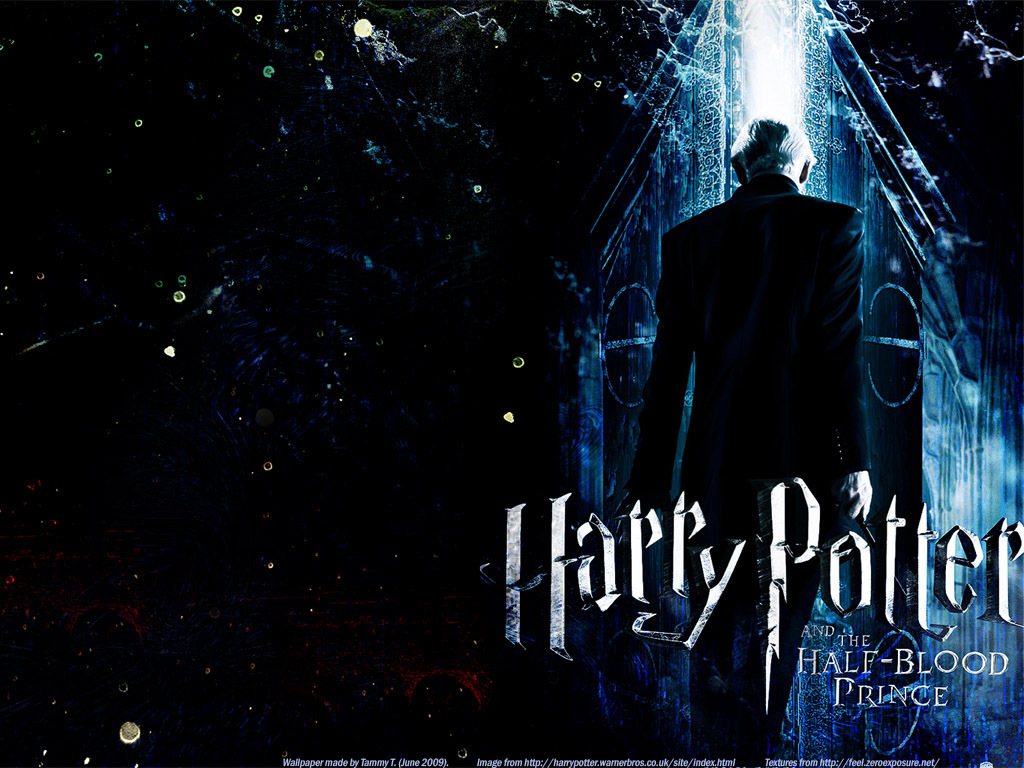
1. Harry Potter and the Halfblood Prince - Aside from burning down the Burrow in the middle of the film (seriously, what was that?), Half-Blood Prince strikes the most succesful balance between Harry Potter adaptation and really freaking good movie. It's a pivotal film, full of dark and impending danger, but it was also probably the funniest of the books, with many, many chapters devoted to the characters love lives and growing up mishaps. In many ways, Half Blood Prince the book was like a breather in between the ominous anger of Order of the Phoenix and the near unrelenting gloom and danger of Deathly Hallows, and the movie carries that sense while still taking the journey of Ron, Hermione and Harry into adulthood seriously. And the climactic journey into the cave and invasion of Hogwarts? Picture freaking perfect.
*Bonus points if you get the punniness of this titleWednesday, November 17, 2010
Harry Potter's Secret Weapon (and sorry, Dumbledore, it's not love)
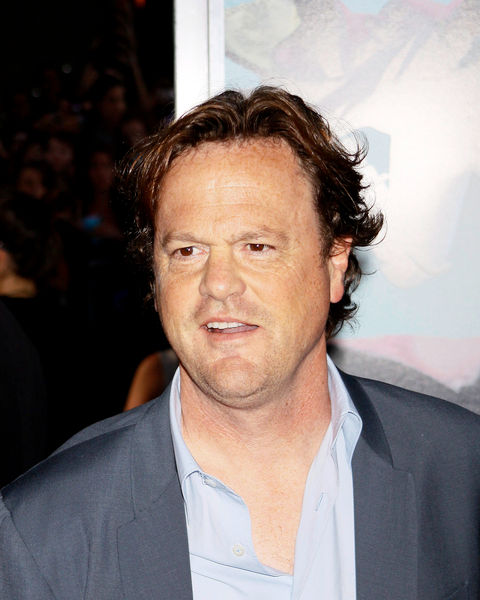
Steven Kloves has written each Harry Potter movie since the first one, with the exception of Harry Potter and the Order of the Phoenix. It's his sure voice and unending devotion to the books that have kept the series consistent and critically lauded (for a popcorn series) since their inception, despite myriad of different directors, producers, even lead actors.
Thinking about the things that have always irked me about the films, the one thing that has stayed consistent was the writing. Most of the flaws come down to direction, acting, or editing. What Kloves nails throughout is the sense of this world, and the legitimacy of that world, and the voice of the characters. Where sometimes plots are shortened or changed (occasionally maddeningly), they still feel like Harry Potter.
This struck me particularly strongly in a scene in my least favorite movie, Harry Potter and the Chamber of Secrets. Harry has just arrived at the Weasley's house after being broken out of The Dursley's. Mrs. Weasley is all atither because the boys stole the magical car, risked the exposure of the wizarding world (and their father's job), and all that other silly motherly stuff. In walks Mr. Weasley, who is more impressed with the fact that his car worked than with his sons' minor larceny. When he meets Harry Potter, the most famous "boy who lived" ever, far from asking about his parents' demise or the face of evil in the form of Lord Voldemort, Mr. Weasley's face lights up as he acts, "What use exactly is a rubber duck?" (/p>
It's a throw away line, taken directly from the books, that simultaneous ekes out laughs and gets to the heart of the Arthur Weasley character. And in a lesser screenwriter's hands, it would have been left out or mangled. It's a small incidence of the commitment to detail and character that has helped to turn the Harry Potter movie series into the landmark that it is, despite the many fan-related issues I may have with it at times.
On top of that, his favorite character to write for is Hermione Granger, and he also adapted one of my favorite Michael Chabon books of all time in the form of Wonder Boys. Steven Kloves, I bestow upon you an order of MyCinema, First Class, for your Devotion to Hogwarts.
* I take a somewhat controversial stance in the re-read-the-book-before-the-movie theory. It is my personal belief that re-reading the books before watching the new movies is dooming the movies to mediocrity, and since I actually think they're pretty good movies, I don't want to do that. Plus, whenever I finish a new film, I want nothing in the world quite so much as to dive back into the book, so I figure I might as well wait.