Sunday, November 28, 2010

Tangled Up

Posted by Rachael

I have a confession to make. Despite years of soccer-playing, action-figure-collecting, comic-book-reading, action-movie-loving tomboy-ery, I've always, truly, wanted to be a Disney princess. But I didn't want to be just any princess: I wanted to be Belle, the confident heroine who ultimately saves herself and her love with her brains and good heart.

This is hardly a unique statement. Generations upon generations of girls the world over have day dreamed about being a disney princess. But it's the neccessary context around which to understand my reaction to Disney's Tangled.

The newest Disney film follows Rapunzel (Mandy Moore) and Flynn (Zachary Levi) as they evade a wicked wit, uh Old Lady, chase their dreams, banter, interact with adorable anthropomorphized animals, and, inevitably, fall in love. It was cliched before Enchanted came out and set it in the real world, but it definitely feels worn in this hour of post-modern Shrek-ery and Pixar films.

But god damn. That so doesn't matter. The beauty of a true Disney film is not in the shocks of the plot (although Tangled is an excellently constructed story), but in the magic that floats off the screen. The animation is top-notch, the voice work across the board excellent, and the songs (as drafted by Disney vet Alan Menken) are fantastic.

top of that, Rapunzel is a heroine for the ages. The movie feels at once classic (there's no meta-winks at the camera, no irony to be found here) and modern (yet the film doesn't feel the need to relegate Rapunzel to a pre-Mulan damsel in distress mode). As voiced by Moore, she's spunky, intelligent, innocent, engaging, and active, constantly working towards her own freedom and her own happy ending. If the feminist in me has always had a sort of love-hate relationship with the princess side of me, both sides happily coexisted while I was in that theater.

A lot of reviews I've read feel the need to explain now what Tangled isn't (oscar-worthy, a Pixar film, going to cure cancer), as if the reviewer feels a little ashamed of how much they fell in love while in that movie theater. But screw it. If my life was the Disney movie I wish it was, then walking out of that theater I was in full blown ballad-mode, and not the beginning, heart-felt longing ballad, but the near end of movie I'm so happy my head could burst ballad. And if that's all a movie has to give me, I feel no need to appologize for my adoration of it.

Disney recently announced that Tangled is the last of their princess movies, and seeing the film made me realize what a shame that truly is. It isn't just the songs or the pretty dresses or the cute animals; it's the princesses themselves who, when done right, are much better than just future dolls, they're the fully-realized version of who we wish we were. and as long as the princesses are as fantastic and interesting as Rapunzel, that's a good thing.

Saturday, November 27, 2010

'Tis the Season...

Posted by Rachael
For Christmas movies.

The "Holiday" season has never really begun for me until I allow myself to slip into the pop culture cocoon of movies, tv shows, and music specifically designed to activate the heart tingling part of us all that wants to give ourselves over to childish optimism. And nothing is quite as essential as the Holiday movie parade, those classics and not-so-classics of the silver screen that annually grace my home theater in the hopes of capturing some christmas joy.

I have a lot of Christmas movies, so this year I'm going to chronicle my way through them as I watch them. Christmas is a process for this half-jewish girl, that starts the day after Thanksgiving on my mother's couch and ends on Christmas night at the movie theater. In between is a cornucopia of different films, in varying degrees of quality and belovedness.

The first movie on this year's docket is Love, Actually. It's purposefully a "new" classic. It's one of those movies that I have legitimately watched over 15 times and it never really gets old.

It's not that I think Love, Actually is one of the best movies of all time, or even the best Christmas movie of all time, although I do think that sometimes people refuse to see the excellent movie beneath the cliches. But the real reason why Love Actually makes this list is because of that the delightful mixture of old fashioned optimism with sometimes uncomfortable levels of reality that somehow makes Love Actually one of the most uplifting and hopeful movies of all time.

On top of that, it is a movie drenched in the popular culture infused wrappings of modern day Christmas, where pop songs and movies coexist with nativity plays at schools and private celebrations at home. It's love is hard won, whether its the midlife itch of Alan Rickman or the brotherly love that is all that's left for Laura Linney. And if at the end you're not singing along with Uncle Billy as he croons, "So if you really love Christmas, come on and let it snow," then you're probably a grinch. Or possibly Jewish.

Wednesday, November 24, 2010

...And The Deathly Hallows

If I were to remake the list below, Deathly Hallows would easily and handily fall at number 1. It wouldn't even be a debate. Let's just get this out of the way, right here: to me, Harry Potter and the Deathly Hallows was easily the best film of the series, the best adaptation of a Potter book, and one of the best films of this year.

In a lot of ways, DH represented the perfect melding of book and movie. Freed from the crunching time constraints that the last four books have had to deal with, and with a fanbase that have almost all aged out of tweendom and strongly into "legitimate adult audience" world, Deathly Hallows is, appropriately, the most adult and compelling of the films.

I'm going to attempt not to conflate the book's excellence with the movie's own excellence. Of course Deathly Hallows tells a deeply fulfilling and appropriate story: we already read the damn book. JK Rowling's concluding chapter was a masterpiece of devotion to theme and character and the culmination of years of effort. But the movie lives up to this standard by taking the excellent material laid down and making it come to life cinematically.

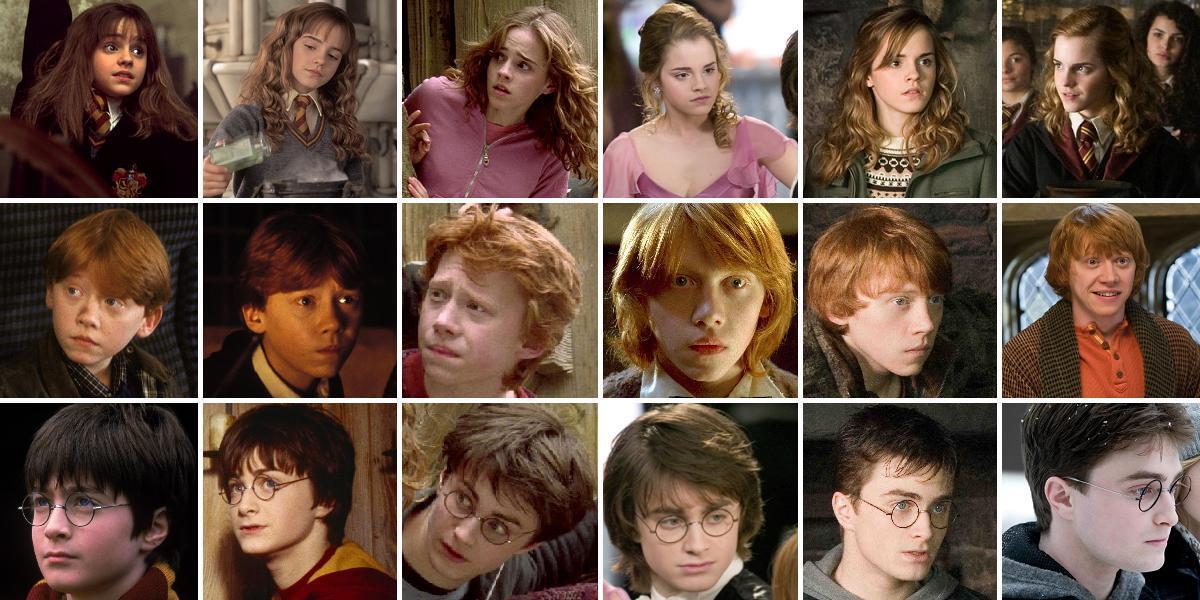
As directed by David Yates, far less of the Harry Potter emotional journey is spelled out than ever before. The characters are going through some of the most intense emotions they've ever felt, but gone are the days when they will, child-like, spit it all out at the camera. Yates has such faith in his actors and audience that finally the series lets subtext remain subtext. You don't need to be told every detail of what's going on. We don't need Harry, Ron or Hermione to ever monologue about how weird it feels knowing the whole fate of the wizarding world lies on their shoulder, or how much more serious the danger is in this installment. In true cinematic form, we can tell from the imagery (Hermione's hands caked in Ron's blood, the casual death of a Hogwarts professor, Harry and Hermione's make out scene) and from the quiet moments (like Hermione's thoughtful line as the trio stands alone in Grimmauld Place, "We're alone.").

The way you can really tell that this is an excellent adaptation of the books is in the stuff that it just plain makes up. From the first shot of Hermione wiping her parents memory to protect them (which is mentioned in the book but not shown), you can tell that Yates and Kloves understands exactly what this means and they're counting on you to get it too. And damn if Emma Watson isn't knocking it out of the park, showing both Hermione's steely, bad-ass determination and how much it deeply hurts her to have to do this to her parents at the ripe old age of 17.

Or take the oft-discussed tent scene. It takes place right after Ron has (spoiler alert) left Hermione and Harry in a fit of horcrux-and-jealousy-induced rage. Hermione has been a vacant mess. Harry, being a good friend, starts goofy dancing with her to cheer her up. But they're also to mature individuals who are stuck in a bleak, cold world with little help, and there's a tiny moment between the two where it almost seems like this is going to a very non-canonical place. The ultimate decision by both characters to realize what their relationship really is therefore seems both more honest and more profound for the movie having gone to a place that the book never had to. It's both true to these characters and completely fabricated, and it provides a very vivid portrait of both the grace and realisticness of Harry and Hermione.

The fact that the added details feel perfectly in place is the greatest indicator that this movie, even more than any of the other films, gets what made the books worth it.

I could write a book full of praise for the main three's acting in this film. Gone are the days of awkward line readings, forced emoting, and eyebrow acting. All three main stars have blossomed into something fantastic. But if I had to give an award for best performance, it'd go to Emma Watson, hands down. I've mocked the girl who took my role for years. She was the weakest link for a while. But Watson provides such a painful, quiet, deeply flawed and wounded and yet strong and badass performance as Hermione that it made me love one of my favorite characters of all time even more for having seen it. There's another tent-scene, where Hermione slips back into her old school-girl esque habits ("Actually, I'm highly logical...") in which you can really tell just how far Watson has come from the old "Wingardium LeviOsa" days.

Some people are claiming the movie feels like only half a film, or is somehow unsatisfying, and I guess I can understand that, but for me, Deathly Hallows was everything it needed to be and more, and a beautiful testament to why it's worth it to adapt beloved books to film.

Harry Potter, the book and movie series, hasbeen such a profound part of my life for so long that the discovery of new levels of enthusiasm was a pleasant and fantastic surprise. The reason why it's ever worth the effort to adapt a book to a movie is not just to make money but, in a movie like Deathly Hallows, its the pure unadulterated joy that can come from watching a new work of art being spun from something amazing to begin with.

Harry Potter: A History*

Everytime I've tried to sit down and review the most recent installment of Harry Potter, I felt overly burdened by the attempt to unpack all my (and any tried and true Potter-fans) baggage walking into the theater. The baggage weighed down the review, until all cinematic point was lost, but I felt that the review was dishonest with out it. And then, like Barty Crouch Jr. provided Triwizard tournament hint, an idea struck me: why not just get all the baggage out of the way in its own post?

In other words, this is a post about the history of the Harry Potter film series, as I see it. Up front, keep in mind that I am a rabid, if not super-rabid, Harry Potter fan, who has shown up for the midnight release party of the last three book, and who received her first copy of Harry Potter at the tender age of 11. It is an understatement to say that this series has been a huge part of my life.

However, I was also a film major. That's not to say how fancy-pants I am, nor say that I am inherently more qualified to judge films, merely to point out that I have often been able to let my fan ardency for exactitude fade to a quiet whisper while watching a Harry Potter film (as will become abundantly obvious in the following list). So without further ado, here's my top six pre-Hallows Harry Potter films, in order from least-beloved to most.

6. Harry Potter and the Sorcerer's Stone- In an overly pithy sentence, it's as though the book version of Harry Potter has cast a "petrifiucs totallus" spell on the movie's first installment. With unoriginal direction by Chris Columbus, and combined with an over adherence with the book's minutiae, the Sorcerer's Stone completely fails to capture the magic of Harry Potter that has kept fans enchanted for so many years. Movies and books are inherently different mediums, and adapting one to the other requires more than just cutting stuff out for time- it requires a complete transfiguration.

5. Harry Potter and the Chamber of Secrets- The same issues plagued the second film, although the danger of the Chamber of Secrets somewhat ups the stakes for this one and makes it a little more engaging.

4. Harry Potter and the Order of the Phoenix - There's not much to say about Order of the Phoenix. It takes the longest book and makes the shortest movie. Along the way, a lot is lost. This is good (even JK Rowling claims the books to damn sprawling and could probably use a good weed whacker editing job) but it makes it a less satisfying adaptation. I remember seeing it for the first time and kind of feeling as though I'd just watched a montage of important Harry Potter moments rather than one cohesive film.

3. Harry Potter and the Goblet of Fire - Goblet of Fire was probably the most cinematic of the books. It tells a straight forward adventure tale of a too-young boy entered into a dangerous contest, and it has a natural ebb and flow along the lines of the three challenges that makes it really easy to transcribe to film. Mike Newell, the first British director to helm a HP film, turns the tale into a fast-paced school boy yarn, weaving the magical elements with the under dog elements. It makes it all the more startling when, at the end of the film, the tone shifts abruptly. The death of Cedric Diggory, and consequent return of Voldemorrt are where both the books and the film abandoned the pretense of safety, and it's an appropriately moving moment in the film. However, the film loses major points for its ending. So Voldemort's back and Cedric, Harry's rival in love, Quidditch and Tri-wizardry, has just been brutally murdered before their eyes. Basically, everything's gone to shit. So why does the film end with the trio playfully ruffling each other's hair? It's a dishonest moment within the film's universe that threatens to undermine the story's legitimacy. Also everyone has REALLY bad hair.

2. Harry Potter and the Prisoner of Azkaban - Alfonso Cuaron changed it all. When he took over the Harry Potter reigns for the series' third part, he famously decided on a theme for the stories to follow and then slashed out everything that didn't pertain to that theme. This means that Azkaban is, by far, the WORST adaptation of the books. But it just might be the best movie. By deciding to focus on theme and cinematic excellence, Cuaron allowed the series to move away from a cheesy kids movie and into the deep, wonderful series that we knew and love. On top of that, his "serious director" prowess was the first step towards building actual actors out of the trio at the heart of this film, rather than just treating them like adorable props. But his overall lack of reverence for the source material IS problematic, and that's why despite the movie's excellence, Azkaban falls back to number 2.

1. Harry Potter and the Halfblood Prince - Aside from burning down the Burrow in the middle of the film (seriously, what was that?), Half-Blood Prince strikes the most succesful balance between Harry Potter adaptation and really freaking good movie. It's a pivotal film, full of dark and impending danger, but it was also probably the funniest of the books, with many, many chapters devoted to the characters love lives and growing up mishaps. In many ways, Half Blood Prince the book was like a breather in between the ominous anger of Order of the Phoenix and the near unrelenting gloom and danger of Deathly Hallows, and the movie carries that sense while still taking the journey of Ron, Hermione and Harry into adulthood seriously. And the climactic journey into the cave and invasion of Hogwarts? Picture freaking perfect.

*Bonus points if you get the punniness of this title

Wednesday, November 17, 2010

Harry Potter's Secret Weapon (and sorry, Dumbledore, it's not love)

In the lead up to this week's world premier of the first half of the last book of the Harry Potter series, a series that has defined my pop culture existence since I first picked up the hard cover in 1998, I've been re watching all the movies*. It's pretty accepted logic that the movies have greatly improved as they've gone along. But in re watching the first two, both of which I've always more or less written off due to the awkward acting and poor direction by Christopher Columbus, I was struck by just how fantastically written they are.

Steven Kloves has written each Harry Potter movie since the first one, with the exception of Harry Potter and the Order of the Phoenix. It's his sure voice and unending devotion to the books that have kept the series consistent and critically lauded (for a popcorn series) since their inception, despite myriad of different directors, producers, even lead actors.

Thinking about the things that have always irked me about the films, the one thing that has stayed consistent was the writing. Most of the flaws come down to direction, acting, or editing. What Kloves nails throughout is the sense of this world, and the legitimacy of that world, and the voice of the characters. Where sometimes plots are shortened or changed (occasionally maddeningly), they still feel like Harry Potter.

This struck me particularly strongly in a scene in my least favorite movie, Harry Potter and the Chamber of Secrets. Harry has just arrived at the Weasley's house after being broken out of The Dursley's. Mrs. Weasley is all atither because the boys stole the magical car, risked the exposure of the wizarding world (and their father's job), and all that other silly motherly stuff. In walks Mr. Weasley, who is more impressed with the fact that his car worked than with his sons' minor larceny. When he meets Harry Potter, the most famous "boy who lived" ever, far from asking about his parents' demise or the face of evil in the form of Lord Voldemort, Mr. Weasley's face lights up as he acts, "What use exactly is a rubber duck?" (/p>

It's a throw away line, taken directly from the books, that simultaneous ekes out laughs and gets to the heart of the Arthur Weasley character. And in a lesser screenwriter's hands, it would have been left out or mangled. It's a small incidence of the commitment to detail and character that has helped to turn the Harry Potter movie series into the landmark that it is, despite the many fan-related issues I may have with it at times.

On top of that, his favorite character to write for is Hermione Granger, and he also adapted one of my favorite Michael Chabon books of all time in the form of Wonder Boys. Steven Kloves, I bestow upon you an order of MyCinema, First Class, for your Devotion to Hogwarts.

* I take a somewhat controversial stance in the re-read-the-book-before-the-movie theory. It is my personal belief that re-reading the books before watching the new movies is dooming the movies to mediocrity, and since I actually think they're pretty good movies, I don't want to do that. Plus, whenever I finish a new film, I want nothing in the world quite so much as to dive back into the book, so I figure I might as well wait.

Wednesday, November 10, 2010

First Look: The New Muppet Movie

Take an exclusive first look at this photo from the new Muppet movie. Now I dare you not to love Jason Segel (not to mention all the other wonderful cuddly creatures in this photo!)

Tuesday, October 12, 2010

The Social Network and Sexism

Sometimes I think I see sexism in movies where there isn't any. I think that I am oversensitive when I whine about the portrayal of women in Hancock, or the dearth of legitimate female friendships, or the double standard represented by the MPAA's recent decision to categorize "male nudity" as separate from "nudity," while maintaining that female nudity is just "nudity."

But then other people start whining about something fairly innocuous in a brilliant film, and I realize I'm actually quite sane. The recent internet controversy over perceived gender discrimination in a film revolves around The Social Network, I guess because whenever a movie has that high of an approval rating on Rotten Tomatoes people need to find something to whine about.

The claims basically stem from the fact that the few women in the film are either a) crazy, b) topless or c) Rooney Mara (who one article refers to as "the bitch who got away"). This is pretty indisputable, although I'd throw in Rashida Jones as a relatively positive female force in the film. In fact, Jones' character is the only one able to get through to Jessie Eisenberg's Zuckerberg, and she provides the film with the closest it has to a summation of purpose. But okay. Let's discount her, since it's a pretty gender neutral role and besides does one female lawyer really undo the rest of it?

Well, my point is not that The Social Network has a lot of positive female characters. It's that why the hell should it? As someone who has searched throughout my pop culture career for female characters who are as daring and interesting as their male counterparts and often found the selections wanting, I can still see that not every movie needs to be about female empowerment. That would get kinda dull.

.

More importantly, the story of facebook as streamlined by Sorkin and Fincher in The Social Network, is a story in which every single character is defined solely by their relation to Eisenberg's Zuckerberg. Andrew Garfield is a wimpy loyal noob* incapable of saving himself from irrelevancy. Justin Timberlake is an almost lustfully appealing go getter turned pathetic self-defeating drug addict. The women, therefore, that surround them represent Mark Zuckerberg's (or at least Sorkin's fictional version of Zuckerberg's) view of women, and more specifically the type of women who would come into his life by virtue of that being his view of women.

More importantly, the mere categorization of Mara's character as "the bitch that got away," displays the view of the author that a woman who objects to being repeatedly told she is stupid, worthless, and inherently in the debt of her male companion is a bitch. That's absurd. No one leaves that scene thinking that Mara was in the wrong to dump the shit out of Zuckerberg.

Anyway, while I understand the urge to criticize popular films, especially for perceived biases, and I think that everyone is entitled to their opinion whether or not I agree with it, I think that sometimes our gender backlash takes us so far away from the real issue that it helps to disguise legitimate claims to sexual discrepancies in cinema and make it all seem to come under the category of typical womanly whining.

And that really makes me sad. :(

*pathetic attempt at incorporating internet slang acknowledge and the author is adequately ashamed of it.

Wednesday, October 6, 2010

The Social Network

Earlier this year my father bought Life Magazine's "100 People Who Changed the World". I read the thing cover to cover. There were tons of omissions, none quite so confounding to me as Mark Zuckerberg, the founder of Facebook. My dad didn't understand why I insisted that the 26-year-old billionaire should be on the list, "Facebook'll be gone in 5 years" he argued. Well, I highly doubt that, I actually think it will morph and grow to the point where there's hardly a need for external websites (really all it needs is a live video chat, a document-sharing/sending method and a comprehensive online shopping component and Facebook will include every top web activity their is). But even if Facebook ceases to exist, the next big thing comes along and usurps its throne, it has already changed the world. It's a noun, multiple verbs and an adjective. It's changed how we interact with one another and how we present ourselves to the world, how stars rise, politicians campaign, humanitarian funds are raised and protests start. Sean Parker and Napster changed the music industry forever, Mark Zuckerberg and Facebook changed the world.

With such scope of influence, every event in Facebook's evolution had the power to affect the entire world. That's the story The Social Network tells, a small story of friends and foes, egos and emotions, jealousies, insecurities and hurt as played out with international reverberations. I've often said that screenwriter Aaron Sorkin's work is Shakespearean in tone: grand, poetic, rich in character detail. But nothing is more Shakespearean than a personal story with larger than life consequences. The intricate and engrossing story of The Social Network is beautifully told and Sorkin's is the perfect unique voice to hear it in.

Perhaps the film's greatest strength is the complexity of its characters. Zuckerberg is neither hero nor villain, but rather a guy, a flawed every man who's surplus of intelligence creates a natural deficiency in social arenas. As played to perfection by indie darling Jesse Eisenberg, Zuckerberg inspires frustration and incredible pathos in almost equal supply. He lacks tact and is a terrible judge of character but he means well, I didn't doubt that for a second. He's remarkable for so many things: his genius, his wit, even some of his priorities (money and female attention take a backseat to ambition and acceptance); and reprehensible for others: his thoughtlessness, his arrogance, his obsession with social improvement and his lack of loyalty (though there's a great moment at the end that throws this particular issue into question a bit). Despite being based on a real person, Eisenberg's Zuckerberg is a film conception, a complex human character rather than an accurate portrayal of the human himself.

The other characters are given similarly complex portrayals. The twin golden boys Cameron and Tyler Winkelvoss (Armie Hammer) who sue Mark for stealing their website idea could easily have become villains, but Sorkin writes them as conflicted good guys both pissed off at being beaten at their own game and cautious of being taken advantage of. Eduardo Saverin (played with pitch perfect empathy by Andrew Garfield), the other character in direct opposition to our "hero", is actually the most easily likable person in the film in my opinion. Unrelentingly loyal until pushed beyond his breaking point and armed with good business sense and an accurate judge of character, Eduardo is the put-upon victim of the film's events. However, his hesitation to join the company in California, his traditional approach to a non-traditional venture and his too-trusting nature make him an easy target. Eduardo also serves as Mark's proxy to the outside world in a lot of ways. He's the translator who understands both the socially strange Zuckerberg and the world he struggles to interact with. At the end of the film, though he's been taken advantage of and stabbed in the back in many ways, one gets the sense that Eduardo will be just fine. But as a particularly heart-wrenching scene points out, he was Mark's only friend. Without Eduardo, Mark is alone. Successful, famous, powerful and alone. It's Mark who's ending has the ring of tragedy to it.

The one character complaint I have is the simplicity of Sean Parker. Compared to the other characters, Parker (played with wonderful irony by Justin Timberlake, one of the foremost musicians affected by the rise of Napster) is not very interesting. He is tricky and engaging but ultimately too obviously devious to really win me over. A more complex portrayal of Parker could better explain the allure he held for Zuckerberg. As it is, that pull shows the weakness of Zuckerberg more than the power of Parker. Although maybe that's the point (and who doesn't love Justin?!)

But what's one tiny little complaint in the world of awesome that is The Social Network?

The intricate characters exist in a cinematic world perfectly constructed by director David Fincher, within a story that is endlessly fascinating, superbly timely and undeniably engrossing. The pacing of this wonderful drama/thriller/origin story hybrid is dead on and the dialogue clever as hell (naturally, with my beloved Sorkin holding the pen). A character-perfect quip about BU's lighter workload effectively has insecure students up in arms and the throw-away use of one of my favourite grammar jokes (Winklevi!) had me cheering with geeky delight. Sorkin makes a quick cameo for the fan with a keen eye, a Facebook aficionado will love the nostalgia of the old-school interfaces from the site's early days and the dorky fun of the drunk livejournaling/coding adventure that kicks off the story sets the tone for the delight of watching really smart people play dirty.

The whole thing is as perfect as it could be for a film with such high expectations attached to it. With The Social Network, Fincher and Sorkin have together created the film that defines right now and how we got here.

Tuesday, October 5, 2010

My Cinema Crush: Jesse Eisenberg

I first saw Jesse Eisenberg* in the 2005 film The Squid and the Whale. In it, he played the mostly unlikeable, snobbish son of a couple going through one of the most nasty divorces ever put to film. The movie showed Eisenberg's transition from gawky, assholeish teen to sympathetic young man against the back drop of his parents' marital decline and childishness, and its his rehabilitation that provides the films backbone. It's a fascinating, frustrating film, that is carried primarily by its then-21-years-old stars fantastic, nuanced portrait.

Perhaps its because of this that I never quite got the Michael Cera comparisons. If anything, way before Juno and Superbad made Michael Cera anything other than George Michael from Arrested Development, I already had Eisenberg on my radar as a young man to watch, who could make the awkward and unlikeable strangely sympathetic and redeemable, and who worked best within complex, beautiful scripts that dealt with universal themes like jealousy, heart-break and what it means to care about other human beings.

This isn't a review of The Social Network. Kelly, as this site's Editor In Chief, has claimed the honor of writing about that breath-taking film. This is about why Eisenberg comes out of it seeming so damn triumphant, and why it's worth taking a look at his previous filmography to establish that this was not a fluke. Eisenberg is a star to watch, a man who can go from charming to awkward to brilliant without batting an eye, but who never sacrifices the reality of his characters for cheap jokes. On top of the aforementioned The Squid and the Whale, Eisenberg has started his career by playing a wide variety of characters in a plethora of highly-praised, semi-independent films. His two most popular films, Adventureland and Zombieland (hmm...), are probably the most responsible for the Cera-comparisions, but they showcase a lot of what makes Eisenberg unique. He radiates an intelligence that is charming, but he's also so legitimately awkward and gawky that he makes his characters' isolation seem believable (Cera, who by the way I REALLY like, in contrast, is always on the normal side of socially awkward, a geeky cutie who girls want to take home and cuddle). He also plays darker, both in Adventureland's forays into heart break and doucheyness, and in Zombieland's lust for zombie death.

But it's his less famous roles that really distinguish him. Whether it's playing an Orthodox Jewish drug smuggler in Holy Rollers or a grown up dealing with his high school bully in The Education of Charlie Banks, he's built an impressive body of work for a 26 year old (let's ignore The Village for the time being). On top of that...

I kind of found his extremely selfish, social awkward, douche bag portrayal of Mark Zuckerberg kind of adorable. I hate boiling down what is a very legitimate argument about a young man's artistic prowess into a squeally, girly, "HE'S SO CUTE," but, well, this is a series of articles called "My Cinema Crush."

I had to seriously question my moral compass when I watched him screw over friend after friend and yet just really wanted to give him a hug. Partially that's cause Eisenberg portrays him with this ferocious, strangely moral intensity that without ever spelling out Zuckerberg's true motivations, we feel that he is operating the best that he knows how within a world that always seems tantalizingly outside his grasp. But partially that's cause Eisenberg makes truly awkward douches redeemable and, yes, adorable.

So there it is, the first in my series of cinematic crushes articles. Jesse Eisenberg, geeky douchebag extroardinaire.

PS. Today coincidentally is Jesse Eisenberg's birthday. Happy Birthday, Jesse. *or at least remember seeing him, since I know that he was in stuff before that ** If you really want to see why this kid is so damn engaging, check out this moviephone video with him, Justin Timberlake, and Andrew Garfield. It takes a lot to out funny-and-laid-back the erst-while boy bander, but Eisenberg damn near pulls it off.

Sunday, September 19, 2010

The Town

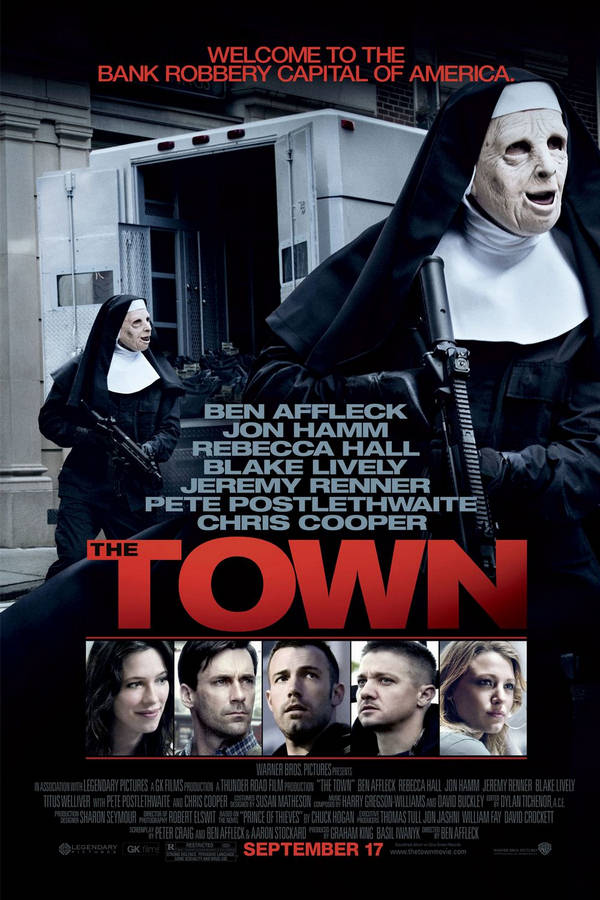
Full disclosure: Although I've never joined a fan club, written a celebrity a letter, or started a blog dedicated to my love for a boy band member, Ben Affleck is the closest thing I have to a life-long celebrity obsession. It's not even a romantic obsession. I don't doodle his name on my notebooks, and I think his wife is pretty freaking fantastic. But I feel deeply and personally invested in Affleck's success. Even back in his Bennifer days, when my much cooler cousins and friends would say things like, "Ben Affleck's only ever been good in one movie- Dazed and Confused because he was playing himself," I was secretely touting his performances in movies like Changing Lanes and Chasing Amy, and referencing his ease and intelligence on talk shows. When other people saw only a gambling, alcoholic pretty boy with capped teeth and expensive taste in jewelry, I was hooked on Project Greenlight and Dogma. So when 3 years ago Hollywoodland came out, followed closely by Affleck's fantastic directoral debut Gone Baby Gone, I felt a personal sense of "I Told You So!"

You might say, then, that I was meant to love The Town. On top of the previous Affleck-related prejudice, it was shot in Boston, so all the locales made me literally squirm in my seat with glee and nostalgia. It starred Affleck himself, plus the always delicious John Hamm (aka Don Draper). And it was a moody, occasionally funny thriller about dubious antiheroes. More or less Rachael catnip.

But that also means that I went in with absurdly high expectations. And The Town met every one of them. I was invested in the tale of Charlestowne bank robbers from the first violent seconds through the moody, beautiful finale.

Affleck directs with an ease and grit that one would have thought impossible from a guy whose only ever created two feature-lengthed films. On top of that, he puts in a career best performance as the "one last job" bank robber at the heart of the film.

There's not much in The Town that, on paper, exceeds the normal trappings of a heist film, but Affleck and his talented crew of actors never make a single second feel obligatory or cliched. There's a palpable energy and authenticity to the film that makes every second a thrill.

Easy A

Teen comedies live or die based on their casts. A brilliant script is a plus, kicking direction can be a boon, and an original concept is always appreciated, but they live or die based on their casts. Think of the very best teen movies (Ten Things I Hate About You, Mean Girls, Can't Hardly Wait, Saved!). Almost all of those have great scripts, good direction, whatever, but what do you remember when you walk out? Heath Ledger crooning "You're Just Too Good To Be True," Rachel McAdams verbally bitch smacking her minions, Seth Green's wangsta chic, or Mandy Moore's hilariously sincere religious zealotry. Good scripts are wasted on crappy casts, but a great cast can elevate a relatively pedestrian script.

Emma Stone is a one-woman great cast. There's a persistent rumor that women can't be funny that no amount of Tina Feys or Anna Faris or Amy Poehler or Lauren Grahams can overcome. I don't blame people. I've seen a lot of movies, and 90% of the time women get few laughs (often at their expense -- oh whoops! I just tripped! hahahahaha, women, aren't they funny?) while they're male counterparts go off on random, extended riffs designed to leave you howling. Emma Stone, however, unlike most of her age group, is legitimately funny. It's not just her lines. She almost never relies on pratfalls. She's not gross out or ridiculous or over the top. She's just funny.

I remember watching Superbad, a movie that lots of people decried as being anti-feminist and boyish, and thinking that the best thing that Judd Apatow, Seth Rogen and crew had done was to cast this strangely down to Earth and witty creature as Jonah Hill's love interest. Sure it was absurd that someone so gorgeous would be interested in Hill's Seth, but damn if Stone didn't seem such a natural in the part that you almost believed her. Over the years, my regard for the actress has only grown, whether she was fighting zombies or battling with crushing stupidity in The House Bunny. She's a natural comedian on screen.

And Easy A is the perfect vehicle for her. She gets to be funny in the same way as male comedians have been allowed to be for years- going off on monologues, getting herself into awkward situations, and generally trying to be the best she can be. On top of that, her character is an amazingly intelligent, self-assured teenager (teenager being the operative word here- even the most self-assured teenagers are prone to bouts of stupidity) and a fantastic one to boot.

Easy A is loosely based off of the ideas of The Scarlett Letter. Stone plays Olive, an ignored but intelligent high school student. When rumors of her devirginization with a college freshman spread like wildfire throughout her small town high school, she enjoys and exploits the attention. When that quickly grows (she tries to help out a gay and bullied friend by pretending to sex him up at a party, which leads to others wanting a similar popularity boost) into full on ostracizing for the supposedly sexually adventurous senior, Olive decides to take a "screw you guys" approach and embrace her outsider status, going so far as to embroider The Scarlet Letter inspired A onto her increasingly scandalous wardrobe.

The plot is decent, and actually touches on some really interesting issues (sexual double standards, marital infidelity, and being yourself in the face of, well, high school), but it's the cast and popping script that make this a movie worth seeing. The script continually dances on the border of being overly cute, but thanks to the direction and the cast it seems as sure footed as a gymnast on the high bar (how's that for overly cute for ya?).

On top of Stone, the rest of the cast shines. As Olive's absurdly chill parents, Patricia Clarkson and Stanley Tucci will make you wish to trade your own parents in, no matter how fantastic they are (sorry mom and dad, just kidding. Comedic exaggeration, don't ya know). They have a natural paternal chemistry with each other and with Stone that truly elevates their scenes. Penn Badgley, as Olive's sort of love interest, is great but never over-shadowing (this is Stone's pic, after all).

The other highlight is Dan Byrd as Brandon, the friend who first convinces Olive to descend into the work of imaginary prostitution, whose comedic rhythms fall into such natural hilarity with Stone that you'll be left wanting more. The scene of their supposed coitus at the party is as hilarious and raunchy as anything Judd Apatow ever produced.

Amanda Bynes is actually pretty wasted in her role as a Mandy Moore-esque Christian boogey man designed solely to torture Olive and provide a punching bag for her verbal snark. Frankly, she seems bored. And Lisa Kudrow is similarly useless in her tiny role as Olive's favorite teacher's wife, who turns out to be rather less than inspiring. But that's okay, this picture doesn't need hilarious bad guys when the good guys are this good.

Easy A is not revolutionary, but movies like this don't need to be. Much like its star, it has the natural charisma to feel like an instant classic, and leave you wishing you were still 14 so you could watch the movie on repeat and not feel like a freak.

Tuesday, August 24, 2010

A Piece of Work

The documentary about Joan Rivers is doing really well. It's gotten a lot of great press, strong ticket sales and a 91% fresh rating on Rotten Tomatoes. It also happens to be really good. It's fascinating, disturbing, funny and tragic.

I've never been a Rivers fan, and the film not only told me why that's true (her jokes are not consistently very funny but are consistently polarizing, she looks like an alien and she's a little off her rocker) but why it shouldn't be (she's tough, feisty, very human and a little off her rocker).

Highlights include footage of a young and vibrant Rivers in her early days on The Tonight Show, the heartbreaking tale of her losing the friendship of Johnny Carson, a scene showing her stomping on a heckler at a standup show (with more wit and heart in those improvised moments than in the rest of her act) and the harrowing reality behind her forced smile at the Comedy Central roast in her "honour". The unsettling opening shots of Rivers applying her thick makeup in extreme closeup are never built on with an in-depth discussion of her plastic surgery compulsion, but strangely it's not her other-worldly aesthetics that hold the fascination of Joan Rivers: A Piece of Work.

I've never known Joan Rivers as anything other than the scary lady making fun of everyone's dresses on the red carpet. But tonight I saw her scared to open her play in New York because she thinks everyone hates her. I saw her confess that no man has ever called her beautiful, ever. I saw her scratch her way back into the limelight after losing everything. I saw her cope with the suicide of her husband and the betrayal of friends. I saw her in her 20s, looking just like Chelsea Handler as she pushed the envelope on what women were allowed to say. I saw her at age 75, staring hopelessly at an empty date book. I watched as she held tightly to her grandson's hand as if frightened he might slip away and listened as she passive-aggressively tossed around Kathy Griffin's name, her comedy descendant and... replacement, really.

The film's most moving moments are when real tears spill over Rivers' botoxed cheeks. When she talks about defending her daughter's honour, Rivers begins to cry. But it's when she reveals that she had to fire her long time friend and manager that she really got to me. The scary lady got to me, and I truly appreciated for the first time that she's a person, not a punchline. She may look fake, but she's real (and tough as nails to boot, not to mention loyal beyond reason). The revelation that with her manager gone she has "no one left to say 'remember when'," is heartbreaking. And when she speaks of being an actress at heart, playing the role of the comedian, her entire crazy persona snaps into focus.

Everyone already knows how this film ends. After winning Celebrity Apprentice, Joan Rivers has been back in the spotlight in the past few months. She's released a new book and been performing steadily. The film goes out with the once-empty date book now filled with work. But the truly great thing is that over the course of a couple hours, the audience has come to care about the scary lady from the red carpet. We get her now: she's very strange, but at the core of it all she just wants people to like her. Doesn't everybody? Joan Rivers has been around for decades, fighting to stay in the industry she loves, no matter how many people try to get her to disappear. She really is a Piece of Work. And now, people who once couldn't have cared less, can smile with knowing that the success of this documentary means that Joan Rivers is still holding on.

Tuesday, August 10, 2010

First Look: The Tempest

In a joint article with other My Entertainment World website My Theatre, here are some preview photos from one of my most anticipated films of the year: Julie Taymour's adapatation of Shakespeare's The Tempest. Due out on December 10 (in the year of the play's 400th anniversary) from Touchstone pictures, The Tempest stars Helen Mirren as a female version of the film's hero, Prospero. Comedian Russell Brand, Alfred Molina, Alan Cumming and Djimon Hounsou also star.


Taymour, who's direction and design for the stage adaptation of The Lion King won her notoriety, praise and Tony Awards, is tackling her second major Shakespeare adaptation with The Tempest. The first is an iconic Titus that is at once brilliant and bizarre. The Tempest promises to be similarly enthralling.

Thursday, August 5, 2010

Salt: predictable, badass and predictably badass

I'll keep this brief, there's not actually a lot to say about this film. The coolest thing about Salt is that the lead role was originally written for Tom Cruise and then tweaked to fit Angelina Jolie. The fact that a skinny chick like Jolie is in practice a hundred times more badass than Hollywood's erstwhile favourite action hero, is pretty darn cool. The film flies by, the stunts are great, the pacing perfect and the performances pretty decent. The story's okay, the effects impressive and the dialogue acceptable. In fact, Salt would be a truly awesome absurd summer movie if it weren't for one thing.

I've heard people complain that she should be dead within the first 10 minutes. I don't actually care about that fact at all. If we were looking at realistic survival statistics James Bond would never make it out of the scrapes he gets himself into. No, I'm all for bizarre heroics and feats of inhuman strength and cunning. My problem is predictability. Let's pretend for a minute that Liev Schreiber didn't accidentally let slip the big twist on The Daily Show (and desperately try to cover it up- to moderate success). I still think I could have seen it all coming

*** SPOILER LINE***

Of course Angelina's one of the good guys- she's the title character! They establish pretty quickly that she loved her civilian husband, we see her withstand torture for her country and she's clearly the most capable and smartest character in the cast. If anyone can think of an example in which such a character was anything BUT the good guy I'd certainly like to hear about it. In contrast, I don't recall ever having seen Liev Schreiber play a good guy. He's always duplicitous. Besides, he comes out of the gate all proclaimed national heroics and over the top personal loyalty- they set him up as perfect, and the perfect guy is NEVER perfect, especially if we hear more about his perfection than see it. Their good/evil flip could be seen a mile away by anyone even remotely familiar with Hollywood tradition. It was pure laziness in an otherwise enjoyably executed action movie. Angelina (just awesome enough to make up for being a little creepy) deserves better from a movie for which she agreed to dangle from a windowsill 11 stories up.

Ramona & Beezus

Beezus and Ramona was my favourite book when I was little. I read it with my mom. Then I read the rest of the series, all 7 of them. I haven't revisited these beloved books in years but, remembering them as a cornerstone of my childhood, I couldn't have been more excited (and apprehensive) when I heard they were making a movie.

But as more and more details about the film reached my ears, my reservations eased. The title (Ramona and Beezus, the reverse of the original book), which annoyed me at first, made sense considering the film would be an amalgamation of all 8 books not just an adaptation of the first one. I was greatly reassured when I heard the sweet story that Beverly Cleary had agreed to sell the rights after all these years only after reading the producer's 4th grade book report on Ramona. But it wasn't until casting began that I knew I would like Ramona and Beezus.

The producers went with a relative unknown for Ramona, the delightful Joey King who would make her mark in the iconic role instead of bringing kid star pedigree to it. The tricky role of Beezus (the sympathetic character as seen through the eyes of her little sister could have looked like a bully) went to Selena Gomez, easily the most endearing of all the Disney Channel princesses, who was beautiful in the role. In a perfect casting stroke of genius, they chose my beloved John Corbett to play Mr. Quimby. Corbett, always charming, always warm, usually goofy, has a wonderful fatherly presence and his 6'4'' frame and baby face give him the perfect balance to simultaneously play hero to his daughters and regular guy trying to get by. The small but fun role of Ramona's teacher went to the always wonderful Sandra Oh and dreamy/fun Tad Hamilton..err... Josh Duhamel would play Hobart. But the piece de resistance would be Aunt Bea. Without the perfect actress to capture Ramona's grownup counterpart, the film just wouldn't be right. But these producers knew what they were doing and made the most perfect of all perfect choices: Ginnifer Goodwin. I adore Ginnifer Goodwin, I've loved everything I've ever seen her play since the day she first captured my heart as the self conscious cellist in Mona Lisa Smile right through to her standout work on Big Love. And as fun-loving, hopeless romantic Aunt Bea she brought the perfect cuddly warmth and kiddie spirit.

And that PERFECT cast was given some great stories to play. With highlights chosen from all the books, Ramona and her Father took centre stage (being the most resonant in today's economy and all) with the love story being borrowed from Ramona Forever. Writers Laurie Craig and Nick Pustay chose all the right stuff from each of the books (almost all of them were represented somehow), making for a beautifully paced, poignant and timely character story.

I laughed the whole way time at Ramona's earnest audacity, Mr. Quimby's sweet antics and Beezus' silly adolescent worries. And from the sisters' heart-to-heart straight through to the bittersweet ending, I cried my eyes out- happy, nostalgic tears, not at all unlike Toy Story 3 tears. It was moving, sweet and the first time something I loved on paper as a kid has ever been made even better by the big screen.